
EXTREME26 Expedition: understanding natural seafloor methane emissions along the Norwegian margin.
The EXTREME26 scientific expedition will depart from Tromsø on 12 May 2026 aboard the research vessel RV Kronprins Haakon for a two-week journey along the Norwegian continental margin. With a particular focus on cold seeps and their role in shaping deep-sea ecosystems, the mission aims to deepen understanding of these features within the broader dynamics of the Arctic Ocean and the adjacent seas. The expedition will conclude in Bergen on 25 May, marking a new chapter in cold seep exploration.
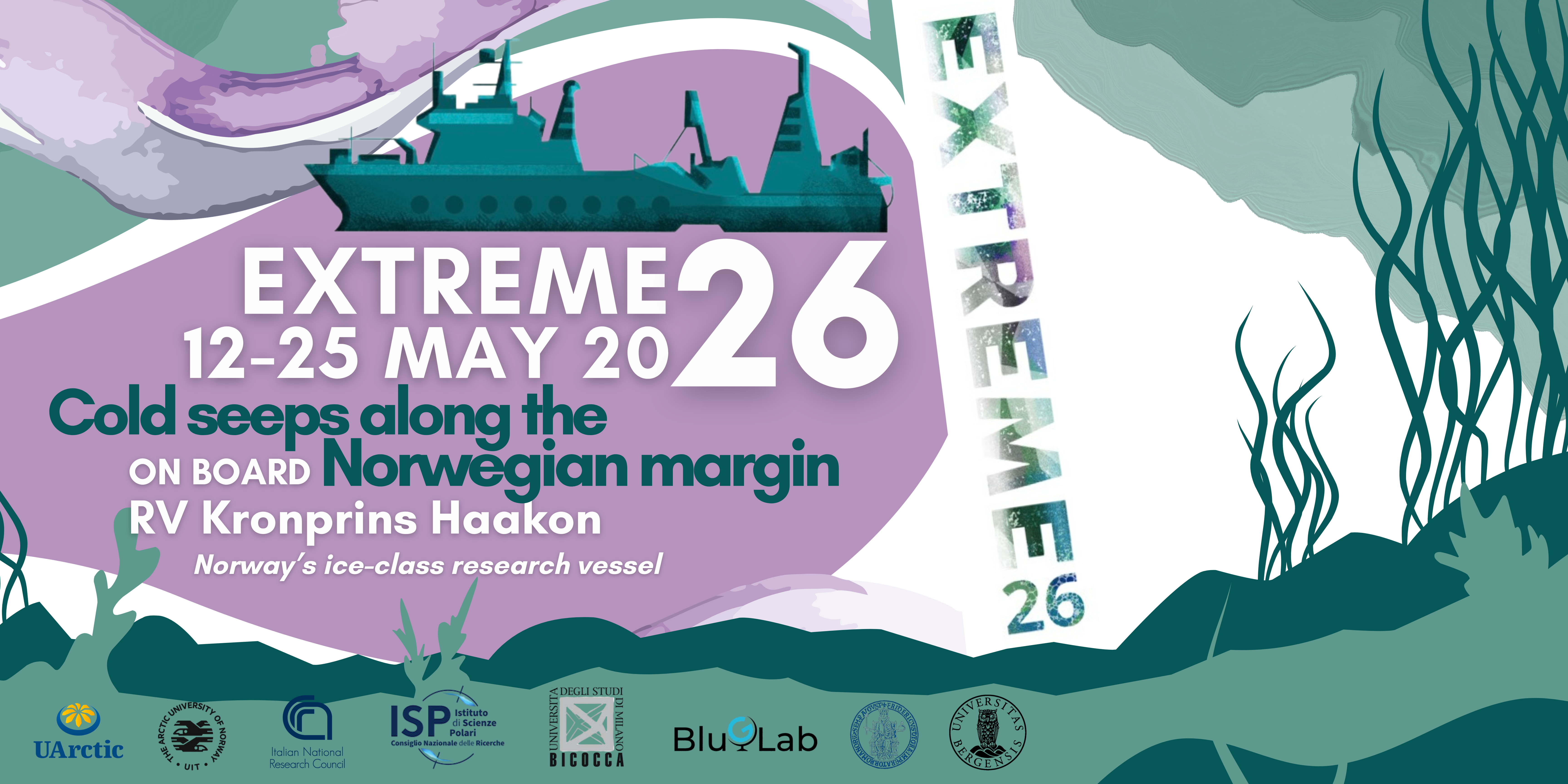
Led by the Department of Geosciences at UiT – The Arctic University of Norway, EXTREME26 is the third phase of the EXTREME program. Building on two years of research and the legacy of the Centre of Excellence CAGE and the AKMA project, the project will continue exploring deep-sea extreme environments, this time in the Norwegian Sea and North Sea, following the discoveries of the Borealis Mud Volcano (EXTREME23), the Freya Hydrate Mounds (EXTREME24), and, most recently, the Frigg Vent Field (EXTREME25), a site hypothesized to be a potential source of abiotic methane in the Arctic Ocean.
The international team brings together scientists and students from leading institutions, including the Institute of Polar Sciences of the National Research Council of Italy, the University of Bergen, the University of Naples Federico II, and the University of Milan-Bicocca. In total, 26 participants will take part in the mission, with more than half of early-career scientists and students, highlighting a strong commitment to training the next generation of Arctic researchers.

At the heart of the expedition lies a pressing scientific question: how do hydrocarbon emissions from the seafloor interact with marine ecosystems, and how might these systems respond to environmental change? Some of the study sites are located in relatively shallow waters, less than 100 meters deep, making them more likely to release greenhouse gases into the atmosphere.
A key role in the mission will be played by the remotely operated vehicle Ægir 6000, Norway’s national deep-sea ROV infrastructure, overseen by the Norwegian Marine Robotics Facility (NORMAR) and the University of Bergen (UiB). With more than a decade of experience and over 1,000 dives, Ægir will collect biological, geological, and water samples while capturing high-resolution footage of the largely unexplored seafloor of the Norwegian Sea and North Sea.


The expedition also strengthens the long-standing scientific collaboration between Norway and Italy. Student training activities will be carried out under the Memorandum of Understanding (MoU) between UiT – The Arctic University of Norway and the Department of Earth System Sciences and Environmental Technologies (DSSTTA) of the National Research Council of Italy (CNR), supporting a long-term partnership in research and education.
As EXTREME26 sets sail, researchers aim to better understand how the seafloor, marine ecosystems, and climate are interconnected, revealing new insights into one of the most remote and rapidly changing regions on Earth.

For additional information or to request images, please contact:
Cruise leader: Claudio Argentino (UiT)
E-mail: claudio.argentino@uit.no
Principal Investigator: Giuliana Panieri (UiT and CNR-ISP)
E-mail: giuliana.panieri@uit.no
Communication advisor: Valentina Lanci (UiT)
E-mail: valentina.lanci@uit.no