Lecture at the EUROPEAN ACADEMY OF PAEDIATRIC DENTISTRY (EAPD) - seminar
Frequent use of sedation and general anesthesia in oral healthcare is environmentally not sustainable, as volatile anesthetic agents are potent greenhouse gases that contribute to global warming. Furthermore, nitrous oxide (N₂O) is a long-lived greenhouse gas and also contributes to stratospheric ozone depletion.
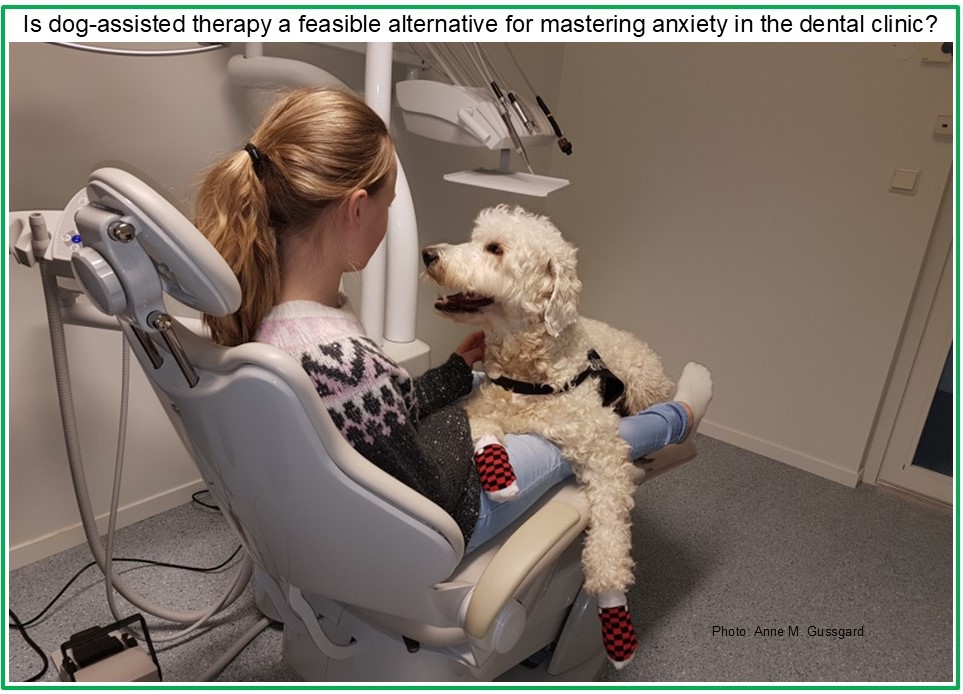
Dog-assisted therapy (DAT) is used in several contexts within various areas of health care. One documented effect is that the proximity of a trained therapy dog may lower anxiety in perceived stressful situations. Many individuals are afraid to visit the dentist, and some to the extent that they need medication or anesthesia to complete their dental treatment. The use of a therapy dog in a dental setting is an anti-anxiety approach that may provide the necessary support to overcome anxiety and achieve this objective, thus avoiding the risks associated with the use of sedation or general anesthesia. I will report findings from our observational clinical pilot study where we have shown that dog-assisted therapy in connection with dental care has a positive effect on children with dental anxiety or children that avoid dental care. (ref. 2017/1078, REC North, NCT03324347, clinicaltrials.gov). Introducing a dental therapy dog team to work with patients in a dental clinical setting creates potential hazards. These seem to be manageable, given proper training and adherence to established clinical protocols. I will discuss potential hazards associated with risks to health and safety to patients, the dental staff and the dental therapy dog in dental clinics who may consider implementing dog-assisted therapy, and I will present suggestions for risk minimization by adopting proposed best practices in dental clinic settings. I will present the importance of proper training of the dental therapy dog and its handler, and I will give examples of different treatment scenarios with a dental therapy dog in a dental clinic, emphasizing the importance that each treatment session with a dental therapy dog team has to be exclusively tailored to the individual patient and that specific appointment.
Starts: 23.04.21 at 08.00
Ends: 24.04.21 at 16.00
Ends: 24.04.21 at 16.00
Where:
Digital
Location / Campus: Tromsø
Target group: Students, Guests, Invited