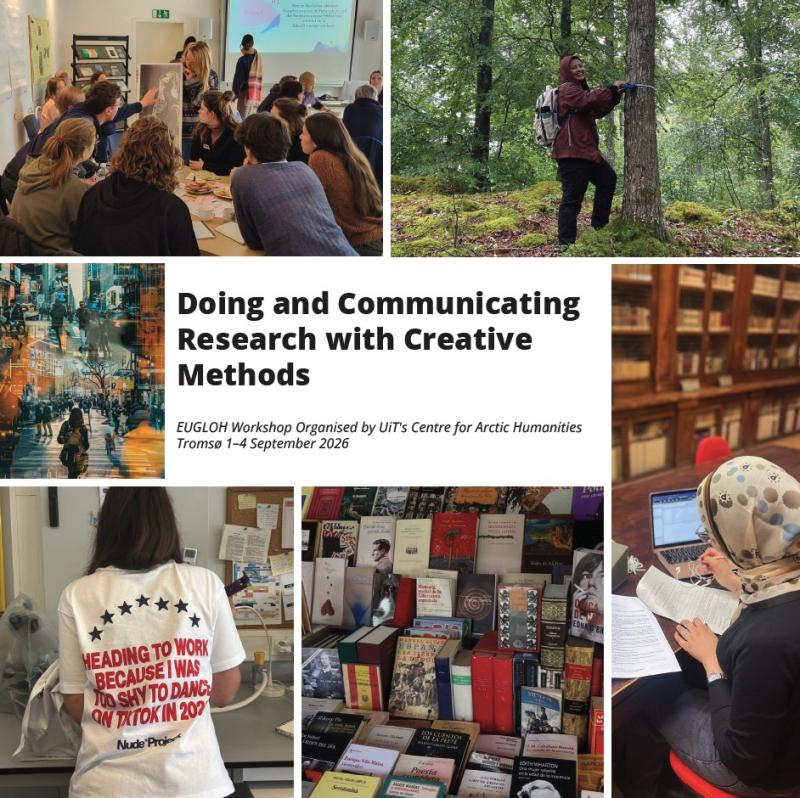
How can we open up opportunities for interdisciplinary projects based on perspectives from both art and science? This question will be explored in a workshop to be held at UiT this autumn.
Dates:
In person: 1–4 September 2026
Online: 30 August 2026
Location: Tromsø, Norway
Host university: UiT The Arctic University of Norway
Mode/type of event: Blended workshop
Target groups: Master’s students, PhD students and undergraduate students
Recognition: Transcript of Records – 3 ECTS
Language: English
Participant selection: Qualitative assessment
Number of places available: 10
Evaluation criteria
Welcome to a space for interdisciplinary Arctic research. This workshop’s flexible format combines an online preparatory seminar, on-site workshop days in Tromsø and a dedicated day for producing a publication.
This initiative is anchored in UiT’s ongoing work at the Centre for Arctic Humanities and has been developed in dialogue with the UArctic Thematic Network on Environmental Humanities. Master’s and PhD students are particularly encouraged to apply, although students at all levels are welcome. Eligible participants will receive 3 ECTS.
Content, Methodology and Selection
Content
The aim of the workshop is to foster creative methods in Arctic research, education and communication. We want to give students the opportunity to understand how creative methods from the humanities can inform practice across the arts and sciences through exploration, experimentation and failure.
The workshop will serve as a testbed for the co-creation of interdisciplinary projects grounded in the participants’ own ideas. By the end of the course, students will publish their collaborative work through a new UiT publication channel, Septentrio Creative.
Methodology
The workshop builds on methods developed during the blended intensive programme, Integrating Co-creativity into Research, Education and Science Communication, and connects to UArctic Congress Session 6, Creating and Communicating Arctic ArtScience, organised by the UArctic Thematic Network on Environmental Humanities.
Key competencies and forms of knowledge developed through the activity include co-creative methods, critical thinking, knowledge into action, social impact, Indigenous knowledges and storytelling.
Selection
This workshop is open to students from the arts, humanities and sciences. Please provide a short letter of motivation and your CV. Students at all levels are welcome to apply, although Master’s and PhD students will be given priority. Eligible participants will receive 3 ECTS for this activity.