Deep-sea coral reef newly discovered on the Norwegian margin during the EXTREME26 expedition led by UiT.
A multidisciplinary team of scientists aboard the research vessel R/V Kronprins Haakon has discovered a previously unreported deep-sea cold-water coral reef in the Norwegian Sea, revealing a biodiverse ecosystem hidden 360 metres below the surface.
By Valentina Lanci
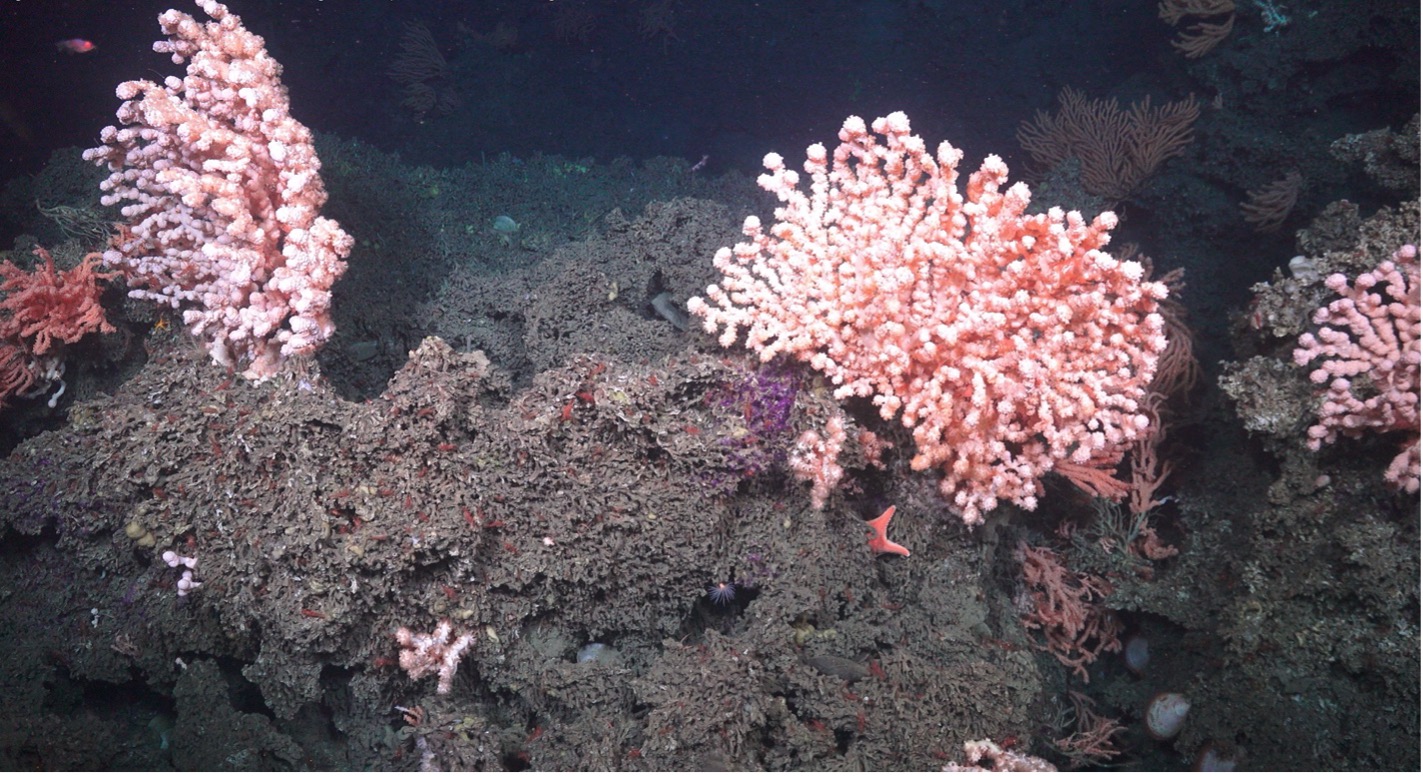
Figure 1: Large colonies of bubblegum coral (Paragorgia arborea) and sea fan (Primnoa resedaeformis) on top of the coral reef (Credits: ROV Ægir6000/Normar-UiB/Extreme 26)
Led by the Department of Geosciences at UiT – The Arctic University of Norway, the EXTREME26 expedition departed from Tromsø Harbour on 14 May to investigate cold seeps and their role in shaping deep-sea ecosystems along the Norwegian continental margin. The mission counts on the remotely operated vehicle ROV Ægir 6000, operated by NORMAR, to conduct high-precision seafloor exploration at great depths, capturing detailed imagery and mapping previously unexplored areas.
During one of these dives, the team made an unexpected and fascinating discovery: a previously unknown coral mound field on the seafloor. The finding quickly became one of the expedition’s most exciting moments, revealing a habitat that had not been documented before.
What makes this discovery particularly interesting is not only what was found, but also how it happened.
Rather than being the result of a targeted search for coral structures, it emerged almost incidentally while the ROV was carrying out a different scientific objective. The discovery, in fact, occurred by chance during investigations targeting pockmarks, which are seafloor depressions formed by focused gas emissions. In this sense, this experience highlights both the unpredictability of deep-sea exploration and the value of high-resolution ROV surveys in revealing hidden features of the ocean floor.
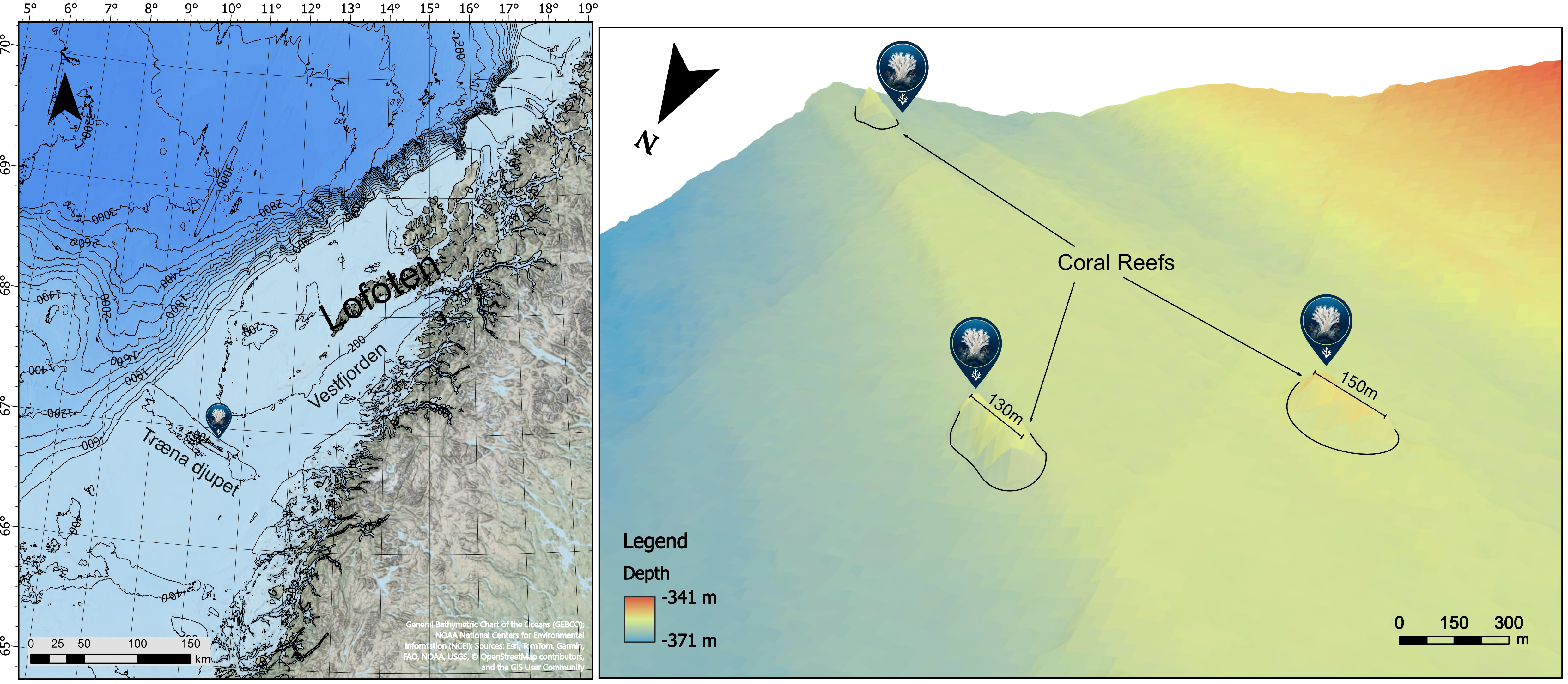
Initial seabed mapping revealed three elongated mounds, each approximately 100 metres long and 30 metres wide, rising nearly 10 metres above the surrounding seafloor. The unusual structures, aligned northwest–southeast, prompted researchers to conduct a final ROV dive to investigate the site more closely.
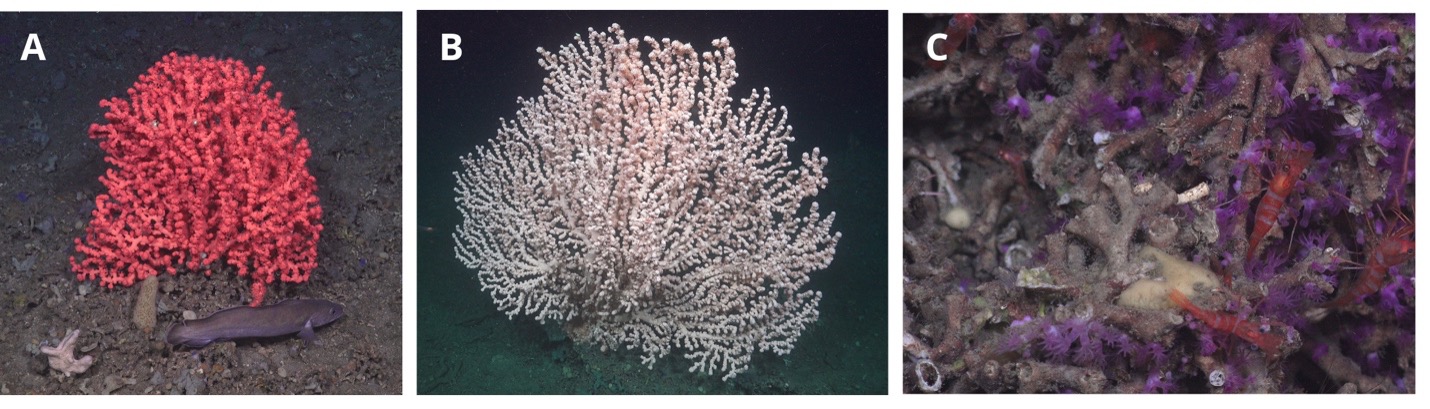
Figure 2. A- Red colour morph of the bubblegum coral with a cusk (Brosme brosme) in the foreground. B - Pink colour morph of bubblegum coral. C- Close-up of reef structure with purple Clavularia polyps and shrimps (Credits: ROV Ægir6000/Normar-UiB/Extreme 26)
Scientists believe the site may represent an important ecological hotspot along the Norwegian Margin.
As Luca Fallati, marine geomorphologist at the University of Milano-Bicocca and member of the expedition team, explained:
“The complex three-dimensional morphology of this coral reef, built over hundreds of years through the accumulation of coral skeletons, provides a variety of microhabitats and supports a remarkably biodiverse ecosystem. These structures are not simply biological communities growing on the seafloor: over time, they actively shape the seabed, creating complex habitats that can be detected and mapped through multibeam and ROV data”.
For Mari Heggernes Eilertsen, deep-sea biologist and researcher at the University of Bergen, one of the most striking aspects was the clear ecological contrast observed during the dive:
“The difference between the surrounding seafloor and the coral structures was remarkable. While the adjacent areas had relatively sparse megafauna, the coral reefs hosted a diverse and colourful community, with numerous associated organisms finding shelter and feeding opportunities among the coral branches. This clearly shows the key role of cold-water corals as habitat-forming species in the deep sea.”
The reef was located in Trænadjupet, a trough carved by glacial erosion during the last Ice Age. While the precise origin of the coral mound cores remains uncertain, preliminary observations suggest that much of the deposit consists of dead coral skeletons, forming the foundation for this unique ecosystem.
Figure 3. Location of the new cold-water coral reef off Lofoten, Norway. The left panel shows the regional setting of the study area along the Norwegian margin, while the right panel presents a 3D seafloor model derived from multibeam echosounder data, highlighting the area where coral reef/mound structures were observed and explored with the ROV at depths of about 360 m (Credits: Luca Fallati – University of Milano-Bicocca)
Norway hosts the world’s highest density of deep-sea cold-water coral reefs, supported by the nutrient-rich waters of the Norwegian Sea. However, this newly identified site had not been documented before, filling an important geographical gap along the Norwegian Margin and expanding scientific understanding of cold-water coral distribution in the region.
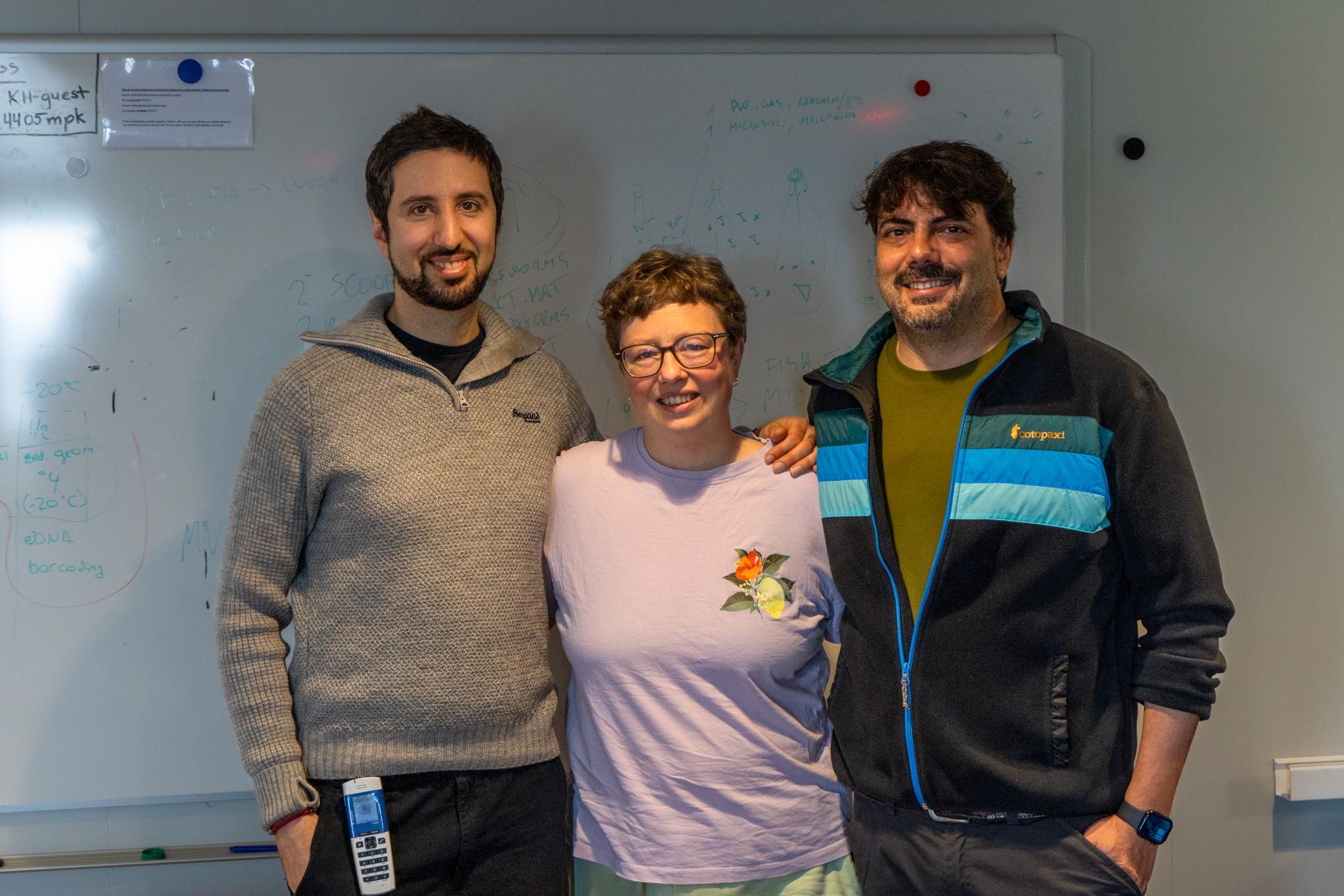
From the left: Claudio Argentino (UiT), Mari Heggernes Eilertsen (UiB), Luca Fallati (Universitá Milano-Bicocca) Foto: Claus Falkemberg (Extreme 26 - UiT)
“This discovery highlights how much of the deep sea remains unexplored, even when it is relatively close to the coastline”, noted Claudio Argentino, expedition leader and geoscientist at UiT. “Even in regions that have been studied for decades, there are still impressive ecosystems waiting to be discovered. The findings underscore both the ecological importance and vulnerability of deep-sea coral ecosystems, which are increasingly recognised as biodiversity hotspots and critical habitats for marine species”.
The discoveries are the result of a collaborative effort involving scientists expert in geology, geomorphology, and marine biology working together aboard the EXTREME26 expedition. Researchers explain that further analysis and exploration will now focus on understanding the reef’s biodiversity, formation processes, and ecological role within the deep-sea environment.