The research groups CRAFT and ENCODE invite to a screening of the Wachowski's seminal science fiction film The Matrix (1999) at Verdensteatret Cinematek on Tuesday March 10 at 18:00. Introduction by Holger Pötzsch (ENCODE). Discussion and q/a after the screening.
An Ethos of Doubt and Resistance: The Matrix
“The Matrix is a system, Neo. That system is our enemy. But when you're inside, you look around, what do you see? Businessmen, teachers, lawyers, carpenters. The very minds of the people we are trying to save. But until we do, these people are still a part of that system and that makes them our enemy. You have to understand, most of these people are not ready to be unplugged. And many of them are so inured, so hopelessly dependent on the system, that they will fight to protect it.”
(Morpheus in The Matrix)
After their success with the innovative movie Bound (1996), The Matrix (1999) is the two Wachowski siblings’ second feature-length production. Starring Keanu Reeves, Laurence Fishburn, and Carrie-Anne Moss among others, the film was a major success and has since acquired status as one of the most important science fiction films ever made. We present it here as part of the ENCODE/CRAFT Future Perspectives series in a remastered 4 K-version produced for the film’s 25th anniversary in 2024.
The Matrix follows hacker Thomas Anderson aka Neo on his endeavor to free humanity from an AI-driven system that has successfully ensnared everyone in a computer-generated perfect simulation of a late 1990s US city environment. Their minds ensnared in this dream world, people are kept oblivious of the real condition of the earth and their own enslavement by machines. Together with a small band of resistance fighters, Neo battles the machines both inside and outside the matrix before engaging a final challenge that will decide the future of humanity.
In 1999, the idea of a physically traversable cyberspace existing in conjunction with material reality and repeatedly overlayering it was still rather new. The Wachowskis were inspired by both French philosopher Jean Baudrillard’s study Simulacra and Simulation and the emergent genre of cyberpunk science fiction novels, particularly the seminal works by William Gibson (e.g. Neuromancer from 1984). The peculiar visions of technology and society presented in these works formed the cultural context and conceptual backdrop of The Matrix.
In their work, the Wachowskis also drew upon earlier attempts to bring Gibson’s fictional universe to screen. In February, ENCODE/CRAFT showed Robert Longo’s 1995-classic Johnny Mnemonic (also starring Keanu Reeves) that was inspired by Gibson’s 1981-short story of the same title. There are many similarities between this film and The Matrix in terms of style, characters, and the aesthetics of the diegetic world – in addition to the somewhat worn trope of the reluctant male hero saving the day in the end.
However, The Matrix is an action movie with clear political undercurrents. It conveys an ethos of resistance where radical doubt is a condition for liberation. The film states an imperative to question what is generally accepted as given, to try to see through veils of deceit, and apprehend the world as it actually is. Such knowledge then, the film suggests, enables insights into the true face of power and oppression thus forming the basis for mobilization and active struggle. The revolutionary message is clear and structured around an exaggeration of the Marxist idea of false consciousness wedded to radical visions of digital simulation technologies and artificial intelligence.
One famous scene conveys this in an emblematic manner. Leader of the resistance Morpheus (Lawrence Fishburn) offers Neo the choice between two pills: Take the blue pill and ‘stay in Wonderland’ or take the red pill and see 'how deep the rabbit hole goes’. This red-pill-versus-blue-pill alternative has since become iconic and is readily invoked by altright agitators in attempts to brand their idiosyncratic positions as insights into the ultimate state of the world. This reappropriation betrays the initial political ethos of the film and opened up for an establishment backlash. Today, almost any system-focused criticism is quickly labelled as irresponsible and the product of sinister workings of visible and invisible enemies trying to undermine trust in our allegedly well-functioning systems and inherently benevolent elite networks. In this discourse, critical thinking and radical doubt are readily recoded as subversion and ultimately treason. Against this background, a screening of this film appears timely today.
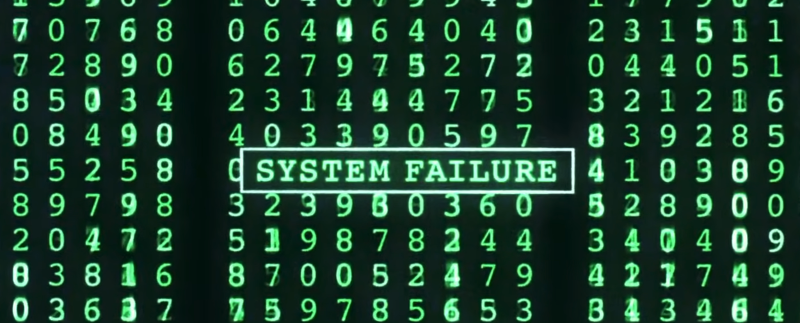
The political attitude of The Matrix is reiterated in the final scene of the film that makes it resonate beyond the diegetic universe or the immediate context of the late 1990s: Quickly moving lines of binary code on a green computer screen gradually recede and give way to the words ‘System Failure’. Then, Neo’s calm and assertive voice directs a call for action at the audience before the films ends with the iconic song ‘Wake Up’ by Rage Against the Machine. Neo says the following:
“I know you are out there. […] I know that you are afraid. You are afraid of us. You are afraid of change. […] I didn’t come here to tell you how this is going to end. I came here to tell you how it is going to begin.”
In essence, The Matrix is a film about manipulation and a quest for truth and liberation beyond the frames of an allegedly unquestionable everyday reality and the interests it serves. This ethos of doubt and resistance is profoundly political and retains its importance today.
Introduction by Holger Pötzsch (ENCODE). Q/A and discussion after the film.
Tickets available at Verdensteatret Cinematek's website.
The screening of The Matrix is the part of the CRAFT & ENCODE (both UiT) film series Future Perspectives.
Holger Pötzsch (UiT/ISK/ENCODE)
When: 10.03.26 at 18.00–20.45
Where:
Verdensteatret Cinematek
Location / Campus: Tromsø
Target group: Employees, Students, Guests, Unit
Contact: Holger Pötzsch
E-mail: holger.potzsch@uit.no