HSE manager tasks
As a manager, you are responsible for ensuring that systematic HSE (Health, Safety, and Environment) work is carried out in accordance with applicable laws and regulations, including the Working Environment Act and the Internal Control Regulations. In this context, a manager refers to the formal leadership position with personnel responsibility in the area.
Preventive HSE work is both the most effective and resource-saving approach to promoting health, well-being, and a safe working environment. This work should be carried out in collaboration with employees and their representatives. HSE efforts play a crucial role in preventing accidents, injuries to people, environmental damage, and material losses.
These pages outline the minimum requirements for preventive systematic HSE work at UiT and how this work should be performed and followed up.
Minimum requirements
As a manager, you must:
-
Have an overview of activities, rules, and requirements at the workplaces
-
Delegate and follow up on HSE tasks
-
Develop HSE goals and HSE action plans
-
Ensure that employees, students, and guests have the necessary HSE competence
-
Conduct HSE smappings and risk assessments, implement measures, and evaluate whether the measures have achieved the desired effect
-
Collaborate with safety representatives
-
Ensure participation in HSE work
-
Follow up on HSE non-conformance
-
Coordinate HSE work with other employers
-
Conduct an annual review of systematic HSE work and report the results of the review through the management line
As a manager, you must ensure that the following are documented in writing:
-
HSE objectives
-
Responsibilities and task distribution
-
HSE surveys and risk assessments
-
HSE action plan
-
HSE non-conformance
-
Annual review of the unit's systematic HSE work (internal control)
Guidelines and useful resources:
Internal control regulations
Regulations on systematic HSE work in companies (Internal Control Regulations)
Establish an overview of HSE regulations and activities
As a manager, you need to establish an overview of HSE regulations and requirements that are particularly important in the workplaces.
On the webpage for central regulations at UiT, you will find an overview of internal and external HSE regulations. For mapping whether work involves potentially harmful health factors, this form can be used.
Delegate HSE tasks
The Working Environment Act establishes that HSE is a leadership responsibility, while each employee is obligated to contribute to HSE work
Responsibilities and task distribition in HSE work at UiT:
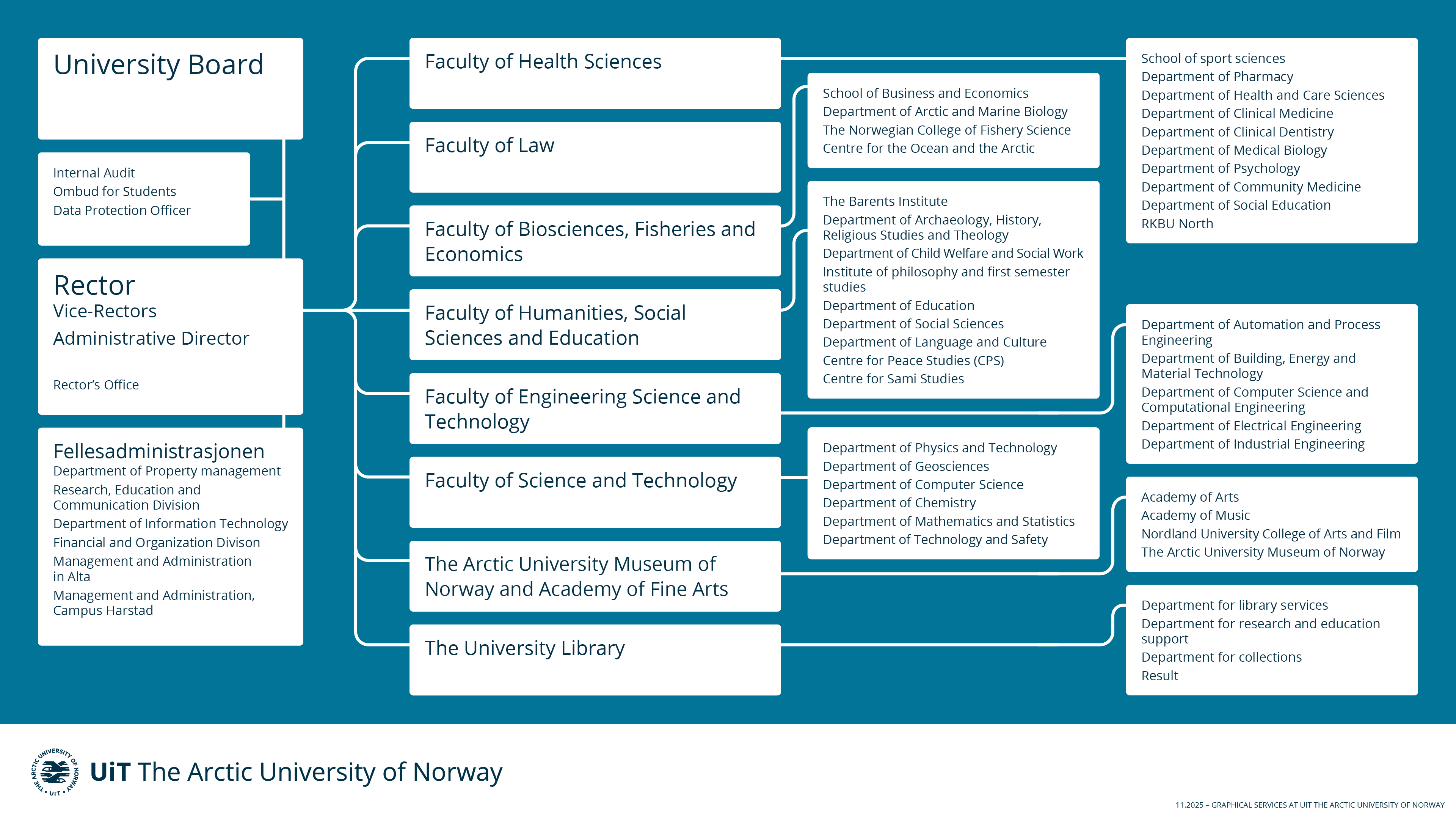
University board and rector:
-
The responsibility for following up on HSE work is delegated from the University Board to the Rector
Managers:
-
Managers have the daily employer responsibility for HSE
-
If a manager delegates HSE tasks within the unit, this must be documented in writing. Form that can be used.
Employees and students:
-
Employees and students must contribute to HSE work
-
Employees and students must take responsibility for their own and others' safety by adhering to UiT's HSE regulations
Safety representatives:
-
The safety representative must ensure that the employer fulfills their HSE responsibilities according to the Working Environment Act
-
The safety representative must participate in the planning and implementation of systematic HSE work within the unit
-
The safety representative must not be assigned extensive or central HSE tasks that could conflict with their supervisory role
Establish HSE goals and action plans
The faculties, departments, and other units at the same level must develop HSE goals and measures that contribute to the university achieving its overarching HSE objectives. The HSE goals must be specific and action-oriented to ensure continuous improvement.
In addition, the annual review of HSE work, as well as the annual HSE surveys and risk assessments, must result in HSE goals and measures that are specific and action-oriented for the areas important to the unit.
HSE goals and measures must be documented in an HSE action plan. The measures must be implemented, maintained, and communicated to employees, students, guests, and coordinating organizations.
- Open communication, presence, mutual respect and trust, and cooperation are prerequisites for a committed and well-informed institution. The managers shall promote a good flow of information and cooperation from staff, students, safety deputies and representatives, and raise issues relating to the working environment during meetings and conversations.
- Staff and students shall complete training, follow routines and guidelines, be attentive, and report risks and non-conformance with the intention of UiT being an educational and stimulating organisation in the field of Health, Safety and Environment.
- Development of a good and safe working environment for staff and students shall be ensured through the integration of Health, Safety and Environment in ordinary planning and follow-up processes at all levels.
- The units shall stipulate goals and plans for activities involving HSE and emergency preparedness that shall be based on corporate goals and mapping and risk assessments for Health, Safety and Environment.
- Guidelines, routines, procedures and information shall be functional and accessible, and include clear distribution of responsibility and tasks.
- The HSE system shall facilitate work in a systematic manner concerning the improvement of the working environment and reduction of risks of injury, accidents and absence due to illness.
- UiT shall offer adapted training to different groups of staff and student, so that the individual is familiar with the relevant risk factors, precautions and procedures that create a safe working and learning situation.
- The buildings at UiT’s disposal shall satisfy relevant regulatory requirements, be adapted to meet user needs and in accordance with principles of universal design.
- All work, study and break areas shall initiate a safe and good working and learning environment, both physically and psychosocial.
- UiT shall work to reduce the strain on the environment through environmentally friendly operation, by mapping environmental impact factors, stipulating goals and working to follow up plans of action at department level.
- UiT shall operate its activities in accordance with the provisions of the Working Environment Act, the regulation relating to systematic health, safety and environment work, and other requirements of importance for efforts concerning Health, Safety and Environment, as well as maintain cooperation with relevant authorities.
Last changed: 05.06.2025
Printvennlig innhold: UiT's overall goals for HSE
The information is only available in Norwegian: https://uit.no/ansatte/hms/lederoppgaver#fastsett-hms-maal-og-tiltak
Last changed: 24.03.2026
Printvennlig innhold: Focus Areas in 2026
Ensure HSE competence
As a manager, you have overarching responsibility for HSE within your unit. To fulfill this responsibility, it is essential that you possess sufficient HSE competence and ensure that employees, students, and guests have the necessary knowledge and skills.
The manager is responsible for:
- mapping and identifying the need for HSE competence and ensuring that necessary training measures are implemented
- offering tailored HSE training at relevant workplaces and study locations
- ensuring that necessary training is completed and documented for relevant users
- ensuring that required safety training is defined as a work requirement in study programs where applicable
As a manager, you are required to undergo training in HSE work, persuant to § 3-5 of the Working Environment Act.
- The training is personal and cannot be delegated
- HSE training for managers is offered, among others, by UiT's occupational health service
Last changed: 04.06.2025
Printvennlig innhold: Legally required HSE training for managers
As a manager, you must ensyre that those to whom you have delegated HSE tasks hae the necessary HSE knowledge and skills required to carry out the tasks.
- Training needs are identified through the mapping and risk assessment of the work.
- Documentation of completed training must be kept at the workplace.
Form that can be used for documentation of HSE training.
Last changed: 05.06.2025
Printvennlig innhold: HSE training for employees with delegated HSE tasks
As a manager, you must ensure that all employees receive HSE training when starting their job.
Employees must, among other things:
- Be informed about HSE regulations and about specific risks related to their work tasks.
- Who is their safety representative
- Be made aware of the importance of reporting HSE non-conformance, personal injury and accidents and how this should be reported
- Be familiar with evacuation routines and routines for notification in the event of acute incidents, as well as preventive training and advice on what to do in a crisis situation
There should be continuous dialogue about HSE, and employees must be kept updated on changes in procedures or working conditions that affect safety.
Form that can be used for documentation of HSE training.
Last changed: 05.06.2025
Printvennlig innhold: HSE training for everyone
Work environment development: HSE assessment and risk evaluation
As a manager, you are responsible for ensuring a safe and healthy working environment for your employees. This includes systematically assessing both the physical and psychosocial work environment in accordance with the requirements of Chapter 4 of the Working Environment Act.
The Norwegian Labour Inspection Authority’s work environment model provides an overview of the requirements set out in the Working Environment Act and helps organisations identify and address factors that may affect the work environment. Further information and guidance on the use of the model can be found on the Labour Inspection Authority’s website.
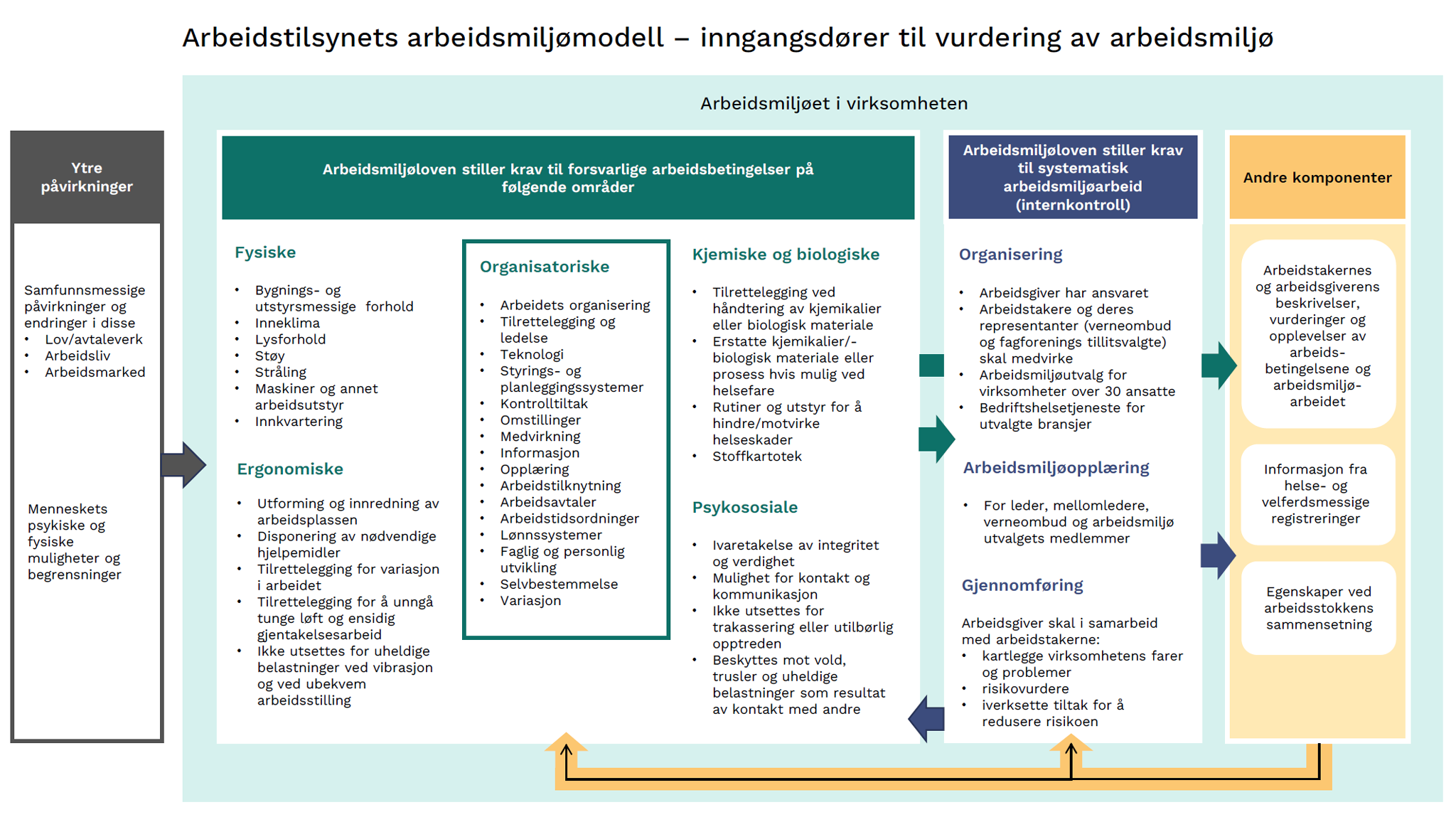
Professional support is available from the occupational health service or the faculty/department HSE adviser to assist with work environment assessments and risk evaluations.
Work environment assessment is the process of identifying factors that may affect well-being, health, and safety in the workplace. At UiT, this is carried out through several key activities:
To assess how employees experience their work environment, UiT conducts a joint Work Environment and Organisational Climate Survey (ARK) every three years.
- The survey provides a basis for developing organisational and psychosocial improvement measures in collaboration with employees.
- The objective is to promote a safe and inclusive working environment with a positive climate for cooperation, free from discrimination, bullying, and harassment.
- The ARK survey fulfils the work environment assessment requirement for all organisational units.
An HSE inspection is a systematic review of premises, equipment, and work practices to identify hazards and areas for improvement.
This includes assessment of:
- Physical working environment factors
- Chemical hazards
- Ergonomic conditions
- Organisational and psychosocial work environment factors
Various assessment templates and checklists are available for local use in connection with HSE inspections.
Where specific challenges or risks are identified during the assessment process, a more formal and detailed risk assessment may be required.
When corrective or improvement measures are needed, it is important to distinguish between:
- Immediate actions required to address urgent issues
- Measures that can be implemented within existing resources and frameworks
- Longer-term improvement initiatives
Planned measures should be documented in the local HSE Action Plan. A template for an action plan is available for local use.
For further information, see HSE and work environment assessments.
Last changed: 09.07.2026
Printvennlig innhold: HSE/work environent assessment
HSE risk assessments shall be conducted as part of each unit’s systematic HSE management activities. This includes:
- Identifying and assessing all aspects of work that may result in personal injury, health complaints, illness, or environmental impact.
- Using available tools, such as local forms or DFØs risk assessment tools, to ensure thorough evaluation and proper written documentation.
Follow-up measures following HSE risk assessments
Any measures identified through the risk assessment process should be documented in the local HSE Action Plan. A template for an action plan is available for local use.
For further information, please refer to the guidance on HSE risk assessment.
Last changed: 09.07.2026
Printvennlig innhold: HSE risk assessment
Laws and regulations
Working Environment Act – Chapter 4
Chapter 4 of the Working Environment Act sets out the requirements for a fully satisfactory working environment.
Regulations Supplementing Chapter 4 of the Working Environment Act
Regulations concerning Organisation, Management and Employee Participation
These regulations specify:
How the requirements for a fully satisfactory working environment are to be implemented in practice. Requirements relating to hazard identification, risk assessment, employee participation, and follow-up. Roles and responsibilities of safety representatives and the Working Environment Committee (AMU).
Regulations Concerning the Performance of Work
These regulations describe how the requirements of Chapter 4 of the Working Environment Act are to be implemented, including with respect to:
Psychosocial working environment Physical working environment Health hazards in the workplace Ergonomic strain and high-risk work activities
These regulations focus primarily on the physical working environment and specify requirements relating to:
Workplace design and layout Indoor climate, lighting, and universal design/accessibility Ergonomic and building-related conditions
Regulations concerning Action and Limit Values
These regulations describe how employees are to be protected from hazards arising from physical, chemical, and biological factors by establishing:
Occupational exposure limit values Action values Infectious risk groups
Guidelines
Guidelines for Systematic health, safety and environment work
Guidelines for Annual Review of Systematic health, safety and environment work (Internal Control)
Forms, Templates and Guidance
- Kartlegging - arbeid med mulig helseskadelige faktorer
- Kartlegging – fysiske, organisatoriske og psykososiale forhold
- Kartlegging – laboratorier og verksted
- Kartlegging – leders HMS-oppgaver
- Skjema for kartlegging av analyseobjekt
- Veiledning til kartlegging av analyseobjekt
- Mal – HMS-handlingsplan
Other Resources
Norwegian Labour Inspection Authority’s work environment model
Last changed: 06.08.2026
Printvennlig innhold: Guidelines and useful resources
Collaboration between manager and safety representative
For the safety representative system to function effectively, managers must facilitate good collaboration and provide favorable working conditions for the system. This requires, among other things, that you:
-
Ensure that the safety representative has the proper competence to perform the role responsibly.
-
Schedule regular meetings with the safety representative to discuss the work environment situation within the safety area.
-
Consult the safety representative during the planning and implementation of measures that affect the work environment within the safety area.
-
Ensure that the safety representative is given the necessary time to perform their tasks responsibly.
Guidelines for facilitating collaboration between managers and safety representatives
Guidelines for the election of safety representatives
Facilitate participation in HSE work
As a manager, you have a duty to ensure that employees can participate in the design, implementation, and follow-up of measures related to the work environment (Working Environment Act § 3-1). This involves:
Involvement in HSE work
- You must facilitate active participation by employees in health, safety, and environment (HSE) work.
- This includes providing employees with the opportunity to give input and participate in processes concerning the work environment.
Information and communication
- You must ensure that employees receive the necessary information about the work environment and planned measures.
- The information must be understandable and accessible to all employees.
Participation in risk assessments
- Employees must be involved in risk assessments and in developing measures to reduce risks.
- This ensures that those directly affected by working conditions can contribute their knowledge and experience.
Facilitation for collaboration with safety representatives
- You must collaborate with safety representatives to ensure that employees' voices are heard.
- The safety representative is an important channel for employee participation
The Working Environment Act § 2-3 also imposes a duty on employees to participate in HSE work. This includes:
- Participating in training and following routines related to health, safety, and the environment.
- Reporting errors, deficiencies, or hazardous conditions in the workplace.
- Contributing to the implementation of measures that improve the work environment.
Practical importance of participation
- Participation contributes to a better work environment because employees often have valuable insights into challenges and opportunities in the workplace.
- It fosters engagement and ownership of HSE work.
Follow up on HSE non-conformance
When you as a manager receiving an HSE non-conformance report, you must:
- Inform the safety representative in the safety area where the HSE deviation occurred.
- Evaluate the case in consultation with the reporter and the safety representative, and identify possible measures.
- Decide on the measures to be implemented.
- Follow up on the implementation of the decided measures.
- Report back to the case handler about planned and implemented measures.
- Monitor the measures to ensure that the corrective actions taken have been effective.
For HSE non-conformances involving personal injury and/or exposure, you must:
- Fill out the form for internal notification of personal injury together with the injured person. The form must be archived in UiT's electronic archive system, Elements.
- For exposure or potential exposure to chemicals, biological factors, or ionizing radiation, fill out and archive the relevant form.
- For injuries that may qualify for registration as an occupational injury and occupational injury insurance, report the to NAV.
- For injuries that may qualify for registration as an occupational injury and occupational injury insurance, complete Part 2 of the personal injury report for the Norwegian Public Service Pension Fund (Statens pensjonskasse). The injured person must complete Part 1.
- For electrical accidents and injuries, report the incident to the Directorate for Civil Protection and Emergency Planning (DSB).
- For incidents involving radiation sources covered by the Radiation Protection Regulations, report the incident to the Directorate for Radiation Protection and Nuclear Safety (DSA).
- For serious personal injury or death occurring in connection with work, immediately notify the Norwegian Labour Inspection Authority and the nearest police station.
Read more about HSE non-conformance here.
Coordination of HSE work with other organizations
At UiT, we shall coordinate HSE work with our partners to ensure a proper working environment in areas where both are located and/or engaged in activity as described in the Working Environment Act § 2-2.
By entering into an HSE coordination agreement, the parties undertake to work together to ensure that activities are planned, organised, executed and maintained in accordance with HSE legislation. The agreement shows who is responsible for coordination (main company) responsible for coordinating HSE work. The HSE coordination agreement shall be in writing and entered into by the managers of the enterprises.
HSE coordination agreements are part of leaders systematic HSE work. The coordination agreement is signed by the managers of both organisations, as well as the safety representatives.
Annual review of HSE work
As a manager, you must annually review the HSE work within the unit together with the safety representative, as described in the guidelines for annual review of the systematic HSE work
The annual review of HSE work should help ensure that the elements of systematic HSE work comply with internal regulations and legal requirement, and to enable targeted measures to be implemented.
Follow up on sick leave
Follow up on sick leave for managers
Guidelines and useful resources
Guidelines
Responsibility and duties in the HSE activities
Guidelines for annual review of the systematic HSE work
Guidelines for the election of safety representatives
Guidelines for facilitating collaboration between managers and safety representatives
Guidelines for systematic health, safety and environment work
Forms, checklists and templates
- delegation of HSE tasts at the unit
- The unit's HSE goals
- Documentation of HSE training.
- HSE annual plan
- HSE surveys and risk assessments
Eksterne lenker
- The Norwegian Labour Inspection Authority on systematic HSE work
- Regulations on systematic HSE work in companies (Internal Control Regulations)