Safety
On these pages, you can read more about high-risk work and the handling of hazardous waste at UiT.
Labs, workshops, clinics
Sikresiden provides information about preventive measures for working in laboratories, workshops, and clinics, as well as guidance on what to do when unwanted incidents occur.
All hazardous activities and tasks must be risk assessed risk assessed to ensure that risk-reducing measures are implemented. To maintain a safe working environment in laboratories, workshops, and clinics, we follow the hierarchy of controls – a prioritization of safety measures. This involves first eliminating or substituting hazards, such as replacing materials, chemicals, equipment, or methods with less hazardous alternatives. Next, technical measures like ventilation and shielding are considered, followed by organizational measures such as training and procedures. Work should, as far as possible, be performed without the need for personal protective equipment (PPE), but PPE is used as a final safeguard when other measures are insufficient. By following this order, we reduce risks and create a safer working environment for everyone.
Fume hood LAF bench (sterile bench) and safety bench First aid equipment Personal protective equipment Room cardsLast changed: 08.05.2025
Printvennlig innhold: Protection and safety measures
At UiT, the substance index Workplace Safety is used. Access to the system requires Feide login. The link will take you to the Norwegian version of the substance index. To change the language, click on the nine dots in the top right corner, select "språk" and choose your preferred language.
You have access to the chemical inventory for your institute or section/department.
The substance index is used to provide an updated overview of substances stored at UiT that are classified as hazardous. This includes chemical substances requiring labeling, health-hazardous biological agents, radioactive isotopes, and pharmaceuticals. The information is provided as safety data sheets and/or information sheets.
It is crucial that the substance index is kept up-to-date at all times because:
-
Employees must be able to find updated information about hazardous substances they work with or that are stored in the workplace.
-
Labels for marking new chemical containers must be retrievable.
-
The information is necessary for conducting risk assessments and overarching risk and vulnerability analyses (ROS analyses).
-
Reports on various groups of hazardous substances stored and used at the university must be retrievable.
-
The information must be accessible in the event of an emergency.
As a user, you only have read access to the information in the chemical database. When new substances are purchased or removed, it is important that you notify your local chemical inventory contact so the system can be updated. It is also important to notify the contact if you discover errors in the inventory. Information about who the chemical database contact is can be obtained from your institute/section/department.
Workplace Safety includes training videos that provide an introduction to using the system.
Under "Regulations and Useful Resources," you will find a recording of the training seminar provided by NetPower to UiT employees on May 22, 2025. Here, you have the option to use AI-generated subtitles for the recordings.
Regulations and useful resourcesLast changed: 18.06.2025
Printvennlig innhold: The substance index
Most chemicals used in laboratories are more or less hazardous with respect to their inherent properties and exposure risks. Hazards can include physical dangers, such as fire and explosion risks, health hazards, and environmental hazards. Everyone working with chemicals must be familiar with the hazard properties. This information is available in the material safety data sheet (MSDS) for each chemical. The MSDS also provides details on first aid measures, fire-fighting procedures, accidental release measures, handling and storage, personal protective equipment, physical and chemical properties, stability and reactivity, and waste disposal. Therefore, it is crucial to review the safety data sheet before purchasing and using a chemical.
All purchases and use of chemicals must be risk assessed.
Elimination of chemicals Substitution of chemicals Storage and co-storage of chemicals Explosive chemical, potentially explosive chemicals and peroxide-forming chemical Pressurized gas and liquid nitrogen Handling chemical spills Regulations and useful resourcesLast changed: 24.10.2024
Printvennlig innhold: Chemicals
Biological material refers to any material containing genetic information that can reproduce either by itself or within a biological system. Biological material should be handled according to guidelines for det handling of biological material. At the UiT, you may encounter biological material in various settings such as laboratories, patient interactions, working with experimental animals, during expeditions, in waste sorting, and in indoor environments. The biological material can be either natural or genetically modified and can range from harmless to hazardous. The routine for the handling of biological material in the laboratory describes how such work should be performed.
Given this, all work involving biological material must be risk-assessed.
Biological factors Genetically modified organisms (GMO) Accidents involving biological material Regulations and useful resourcesLast changed: 11.06.2025
Printvennlig innhold: Biological material
Before starting work with radiation sources, the following must be completed:
- The work must be registered with the central radiation protection coordinator.
- Risk assessments must be completed.
- Necessary local procedures must be prepared
- Local safety training must be completed.
As a user, you are responsible for:
- Familiarizing yourself with and following guidelines, routines, and local procedures.
- Being aware of risks and emergency plans.
- Completing mandatory radiation protection training.
- Using necessary and available protective equipment.
- Reporting nonconformity, incidents, and accidents to the unit manager and the local radiation protection coordinator.
ALARA
The use of radiation sources can cause harm to humans and the environment. Therefore, work with radioactive sources must adhere to the ALARA principle: "As Low As Reasonably Achievable" (the lowest practical radiation dose).
All work with radioactive sources must be well justified, and the benefits must outweigh the risks.
Radiation is divided into two main groups based on energy levels: Ionising radiation and Non-ionising radiation
Ionizing radiation Non-ionizing radiation Support functions radiation protection Regulations and useful resourcesLast changed: 29.08.2024
Printvennlig innhold: Radiation and radiation protection
When working with laboratory animals, it is crucial to ensure HSE for employees. Work involving laboratory animals must comply with Dyrevelferdsloven og forskrift om bruk av dyr i forsøk.
Helsefak - Section of Comparative Medicine (AKM)Last changed: 07.07.2025
Printvennlig innhold: Laboratory animals
Noise is a common challenge in many work environments, and employees and students may be exposed to noise in various situations. Particularly in laboratories and workshops, the use of specialized equipment can lead to high noise levels that may affect both health and well-being.
Examples of noisy equipment
In laboratories and workshops, equipment that generates significant noise is often used. Examples include:
-
Sonicators: Used to break up cells or mix liquids, producing high-frequency ultrasound that can be harmful.
-
Centrifuges: Can create vibrations and noise during operation.
-
Milling machines and drills: Common in workshops and technical laboratories.
-
Ventilation systems, LAF benches/sterile benches, refrigeration/freezer units, and fume hoods: Can produce constant background noise that may become burdensome over time.
-
Compressors and vacuum pumps: Frequently used in laboratory processes and can be a source of noise.
Noise and pregnant individiuals
Pregnant individuals may be particularly sensitive to noise, and it is important to consider this in the work environment. Prolonged exposure to high noise levels can be harmful to both the pregnant individual and the fetus. Employers have a specific responsibility to adapt working conditions for pregnant employees, including minimizing noise exposure.
More information for pregnant employees can be found [here].
Occupational health services and noise mapping
To ensure a safe working environment, the occupational health service can assist with noise mapping. This involves measuring noise levels in various work areas to identify where interventions are needed. Noise mapping provides a solid foundation for assessing risks and planning improvements. The occupational health service also offers hearing tests if noise levels exceed regulatory limits.
The occupational health service can be contacted for guidance and, if needed, training related to noise.
Risk assessment and mitigation measures
Employers are obligated to conduct risk assessments to identify and manage risks related to noise. This may include:
-
Mapping noise exposure: Measuring noise levels and assessing how often and for how long employees and students are exposed to noise, as well as providing information about the associated risks.
-
Technical measures: Installing sound-absorbing materials, using quieter equipment, and shielding noisy machinery.
-
Organizational measures: Limiting the time spent in noisy areas and scheduling noisy activities at times when the fewest people are affected.
-
Personal protective equipment: Ensuring hearing protection is available, providing training on its proper use, and ensuring it is used where necessary.
Last changed: 15.08.2025
Printvennlig innhold: Noise
Fieldwork and sea-going expeditions
In fieldwork and expeditions, academic activities take place outside UiT's regular workplace or campus. Fieldwork and expeditions must be conducted in a manner that is health, safety, and environment compliant.
Fieldwork and expeditions can entail increased risks to people and the environment. Therefore, the risks associated with fieldwork and expeditions must be assessed and evaluated before departure. To mitigate these risks, preventive routines should be developed and relevant measures implemented. Information on potential risks and how to manage them is available at your workplace. The guidelines for safety on fieldwork and seagoing expeditions apply to employees, students, and visitors at UiT. For more information about travel, please refer to UiT's webpage for travel
For Svalbard, there are specific regulations for fieldwork, and those conducting research activities there must familiarize themselves with the applicable regulations. As a general rule, most field activities will require permission from the Governor of Svalbard. The Governor's regulations apply to all employees, students, and guest researchers at UiT who will be working in Svalbard. The governor of Svalbard has regulations for researchers that gives important information regarding these activities.
The content of the Governor's regulations does not provide answers to all questions or detailed descriptions of how to act in every situation. Therefore, it is crucial that you yourself have adequate knowledge and skills to address the challenges described.
Last changed: 11.06.2025
Printvennlig innhold: Fieldwork on Svalbard
For fieldwork and expeditions abroad, you should:
- Carry the phone number of the nearest local Norwegian diplomatic mission.
- Carry the phone number for the Sjømannskirkens (Norwegian Church Abroad) emergency phone; +47 95 11 91 81, with whom UiT has a cooperation agreement.
- Familiarize yourself with the area you will be staying in, for example by consulting the Ministry of Foreign Affairs' (UDs) travel information (Norwegian only), and follow advice from local authorities and, if applicable, the host university.
- For travel safety advice abroad, also refer to PST and the Police Directorate's handbook Sikker reise (Safe Travel).
Last changed: 11.06.2025
Printvennlig innhold: Field work and trips abroad
When diving is to be performed in a work context, the workplace regulations require:
- clear and defined resposibilities
- coordination and staffing of diving assignments
- necessary training
- inspection and maintanance of equipment
- assessment and risk evaluation of diving operations
You can find more information regarding the most essential requiements for diving operations on the Norwegian Labour Inspection Authority's (Arbeidstilsynets) page about diving and the page about regulations for diving. These pages are in Norwegian only.
Last changed: 11.06.2025
Printvennlig innhold: Diving
Guidelines
Routines
Guidance and forms
- Rules for safety on seagoing expeditions involving UiT's vessels and chartered vessels
- Notification of fieldwork and cruise at UiT
- Agreement for paid fieldassistance
Other relevant information
- PST and the Police Directorate's handbook Sikker reise (safe travel) - Norwegian only
- The Ministry of Foreign Affairs travel information - Norwegian only
- The Governor of Svalbard's guidelines for researchers in Svalbard
Last changed: 11.06.2025
Printvennlig innhold: Regulations and useful resources
Hazardous waste
Hazardous waste is waste that cannot be adequately treated along with regular consumer-waste because it may lead to serious pollution or pose a risk of harm to people or animals. The UiT produces many types of hazarodus waste which are sorted and treated according to the Guidelines for handling of hazardous waste.
Chemical waste is waste that contains chemicals which may pose a risk to health or the environment. Examples include:
-
Waste containing chemicals from laboratories, workshops, clinics, fieldwork, and expeditions: New or used chemicals from these types of activities at UiT. This can include pure chemicals or chemicals used in mixtures.
-
Household waste: Products such as paint, cleaning agents, disinfectants, batteries, and pesticides that contain hazardous chemicals.
-
Electronic waste: Electronic devices containing heavy metals such as mercury, lead, chromium, or cadmium. Electronic devices containing brominated flame retardants and other chemical compounds such as PCBs.
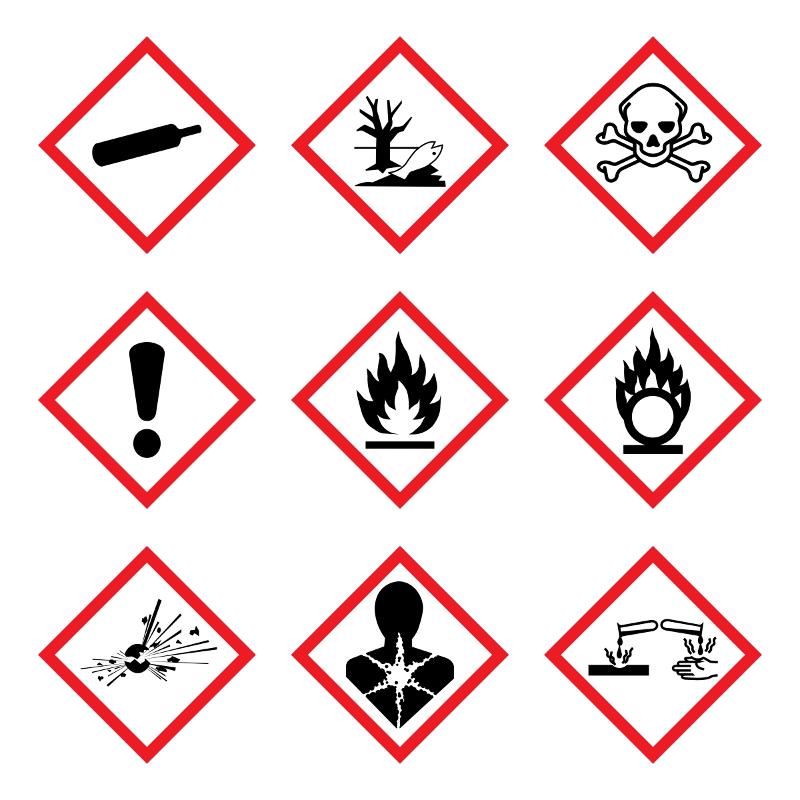
Hazardous chemicals are labeled with one or more hazard pictograms according to the CLP regulation, as shown in the picture below.
Waste management must be part of the risk assessment that is carried out before the purchase and use of the chemical. This means that you must ensure that chemicals you purchase cal also be delivered to the local waste facility. Information about chemicals that require clarifications from the waste management company before purchase can be found in the guidance for chemical waste.
Chemical waste must be delivered from the user in an approved container with a completed chemical waste label. Unlabelled chemicals must not be removed from the laboratory until they have been identified and properly labelled. Information about approved packaging and completion of the chemical waste label can be found in the guidance for chemical waste.
On the chemical waste label, the UN number and waste number must be provided. Use the information in section 14 of the MSDS and the guidance for chemical waste to find the correct numbers in the Sorting form for chemicals based on hazard properties and Waste numbers chemical waste.
Below certain threshold values for specific H-statements, the chemical waste is no longer considered hazardous. An overview of these threshold values can be found in When to classify chemical waste as hazardous waste.
Chemical waste, labeled with a completed chemical waste label and placed in an approved, intact and clean container, should be deliered to the local waste facility according to local procedures.
The contact person for chemical waste at your unit is available to assist with questions regarding waste handling, as described in the Description of function for contact person for chemical waste, problem waste and infectious waste. The table below shows who the contact person is at your unit.
-
NB! You must be logged in with your UiT user account to view the contact persons for your unit. If you are not logged in/cannot see the content, check at the very bottom of this page (in the blue section) to ensure you are logged in. If not, click on the "log in" link.
Last changed: 11.06.2025
Printvennlig innhold: Chemical waste
Problem waste is waste that, due to its appearance, smell, or colour, may raise suspicion and concern.
This includes, for example:
- used disposable equipment, such as pipette tips, disposable gloves, weighing boats, etc
- cadavers and other biological material that is not infectious
- waste that is no longer infectious due to processes such as autoclaving
- autoclaved genetically modified organisms
- sharp and pointed objects that are not contaminated with infectious substances
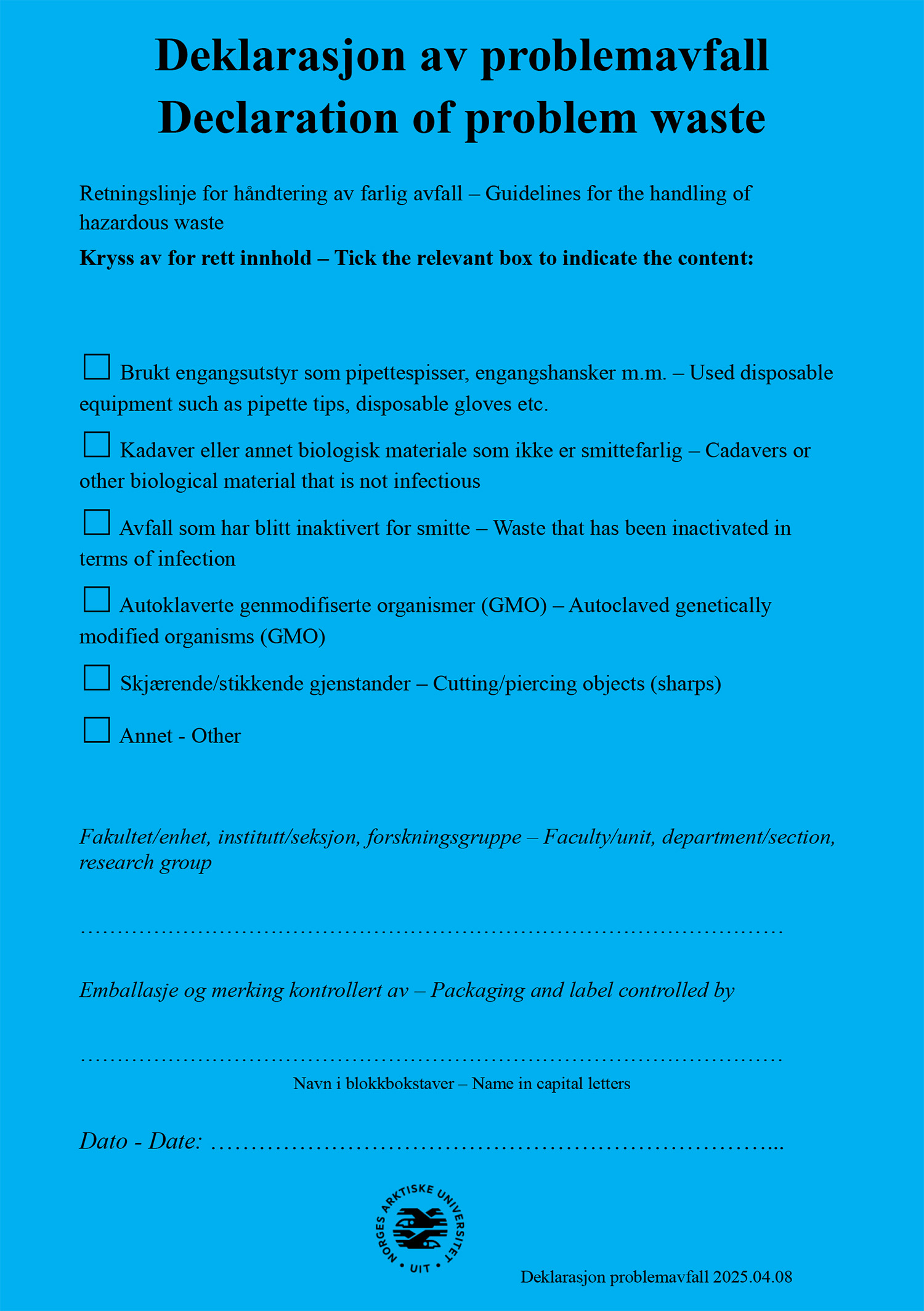
Problem waste is delivered in approved yellow waste containers with a completed blue declaration label, as shown below.
The contact person for problem and infectious waste at the various faculties/departments can provide information on where to find the different labels. Information about who the contact person is at your faculty/department can be found in the chapter on infectious waste.
It is important that when you close the lid on the waste container, your ensure that it is secured all the way around. You will notice that the lid clicks into place when it is properly secured. More information about problem waste can be found in the Routine for the preparation of problem waste and infectious waste for disposal.
Last changed: 11.06.2025
Printvennlig innhold: Problem waste
Infectious waste is waste from work that contains viable microorganisms or their toxins that can cause disease in humans or other living organisms. Examples of such waste include:
- human blood
- human cells/tissue
- animal blood/cells/tissue
- bacteria
- viruses
- other waste contaminated with infectious material
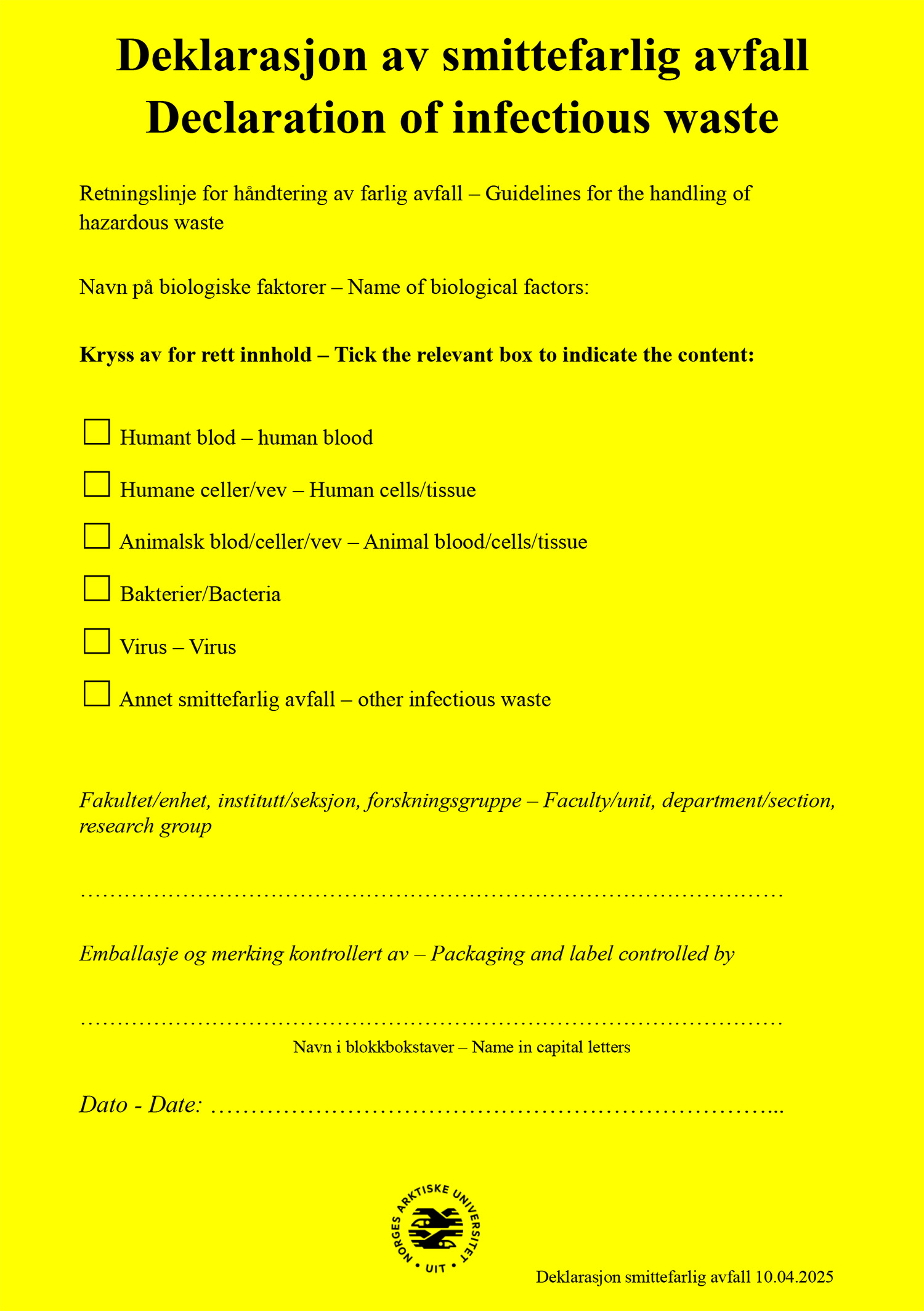
The main rule is that infectious waste should be converted into problem waste, for example, thorough autoclaving. Where tis is not possible, the waste should be delivered in approved yellow waste containers with a completed yellow declaration label, as shown below.
The contact person for problem and infectious waste at the various faculties/departments can provide information on where to find the different labels. It is important that when you close the lid on the waste container, you ensure that it is secured all the way around. You will notice that the lid clicks into place when it is properly secured.
More information about infectious waste can be found in the Routine for the preparation of problem waste and infectious waste for disposal and the Guidance for biological and infectious waste.
Disposal is coordinated by locally appointed contact persons and the contact person in operations for locations on Tromsøya. For locations outside Tromsøya, contact the specialist for problem waste and infectious waste for disposal arrangements.
The contact person for problem waste and infectious waste at your unit is available to assist with questions regarding waste handling.
-
NB! You must be logged in with your UiT user account to view the contact persons for your unit. If you are not logged in/cannot see the content, check at the very bottom of this page (in the blue section) to ensure you are logged in. If not, click on the "log in" link.
Last changed: 07.09.2026
Printvennlig innhold: Infectious waste
Contact the central radiation protection coordinator when you need to dispose of radioactive waste at the central waste facility, located on the 6th floor of MH Vest. An appointment must be made prior to delivery.
Please contact the central radiation protection coordinator if there is a need to dispose of waste that cannot be brought to the central radioactive waste facility at the MH Vest.
Last changed: 09.05.2025
Printvennlig innhold: Radioactive waste
Work with explosive chemicals is generally not permitted at the UiT. The most common explosive chemicals are listed in UiTs Routine for handling of explosive and flammable substances, which also provides more information on their use and disposal.
Certain chemicals can develop explosive properties if stored incorrectly. An example of this is peroxide-forming chemicals. Information on the waste handling of such chemicals can be found in the Routine for handling of peroxide forming chemicals.
Explosives should not be handed over to the local waste facility. The UiT specialist for chemical waste should be contacted for guidance.
Last changed: 07.09.2026
Printvennlig innhold: Explosive waste
Dangerous goods is a general term for chemicals, substances, mixtures, products, and objects that have properties posing a risk to people, property, and the environment in the event of an accident. Most types of hazardous waste are also concidered dangerous goods. UiT has a routine for transport of dangerous goods on public road, along with an accompanying guidance.
During land transport of dangerous goods, the following documents must accompany must accompany the cargo:
- transport document
- transport accident card
The transport accident card specifies measures to be taken in case of accidents and emergencies during land transport of dangerous goods. It is important that the instruction is primted in colour on four pages. No changes are allowed to be made to the instrucions. For more information, refer to forskrift om landtransport av farlig gods (Norwegian only).
Questions regarding the transport of dagerous goods by road can be directed to the ADR safety advisor through faggruppe HMS og beredskap.
Last changed: 07.09.2026
Printvennlig innhold: Transport of dangerous goods by public road
Guideline
Routines and resources for transport of hazardous goods in culverts and corridors
- Routine for transport of chemicals, hazardous waste, gases and liquid nitrogen in culverts and corridors
- Transportuhellskort for intern transport av farlig avfall, laboratoriekjemikalier og gassbeholdere (Norwegian only)
Routines and resources for chemical waste
- Routine for the preparation of chemical waste for disposal
- Waste numbers chemical waste
- When to classify chemical waste as hazardous waste
- Chemical waste label
- Sorting form for chemical waste based on hazard properties
- Guidance for chemical waste
Routines and resources for problem waste and infectious waste
- Routine for the preparation of problem waste and infectious waste for disposal
- Guidance for biological and infectious waste
Routines and resources for radioactive waste
Routines and resources for peroxide forming and explosive waste
- Routine for handling of explosive and flammable substances
- Routine for the handling of peroxide forming chemicals
- Labels for peroxide forming chemicals
Routines and resources for transport of dangerous goods on public road
- Routine for transporting dangerous goods by public road
- Guide for transport of dangerous goods on public road
- Transportuhellskort (Norwegian only)
Description of function
- Description of function for specialist in chemical waste, problem waste and infectious waste
- Description of function for local radiation protection coordinator (LSK)
- Description of function for contact person for chemical waste, problem waste and infectious waste
- Description of function for the contact person in operations for the disposal of problem waste, infectious waste and radioactive waste
- Description of function for central radiation protection coordinator (SSK)
Specialists hazardous waste
- Specialist chemical, problem and infectious waste: Martina Havelkova
- Central radiation protection coordinator: Martina Havelkova
Contact person in operations for problem waste, infectious waste and radioactive waste: Viggo Lorentsen
Last changed: 07.09.2026
Printvennlig innhold: Regulations and useful resources
Working alone
Working alone in high-risk environments should be limited to ensure employee safety and well-being. When working alone, it becomes more difficult to receive immediate assistance in the event of accidents or emergencies, which can worsen the consequences. Additionally, handling unforeseen incidents without support from colleagues can be challenging. Working alone in high-risk environments must be risk-assessed.
You can read more about this topic on the Norwegian Labour Inspection Authority's thematic page on working alone.
Notification and guidance in case of emergency incidents
Your own safety is important if you experience a threatening situation.
Below are some useful resources on preventive measures and personal preparedness when something happens. It is also important that you speak up if you encounter such situations. On the Speak up! page, you will find links to report various types of incidents.
The Norwegian labour Inspection Authority has websites with useful information about violence and threats in the workplace.