About the study
The northern seas harbor a wide range of habitats and a multitude of fascinating organisms, some of ecological and some of economic importance. Knowledge about these is important to understand the impacts of a warming climate and enhanced utilization of marine resources. Advanced technology, new sensors, models, and experimental approaches now allow us to investigate the complexity of the marine ecosystem on spatial and temporal scales beyond ship-based expeditions, in fjords and the open ocean as well as in remote Arctic regions. If you are excited about such questions and opportunities, pursue a Master’s in Biology and specialize in Arctic Marine Ecology.
This study programme requires compulsory attendance to the introductory meeting. See this web page for more information.
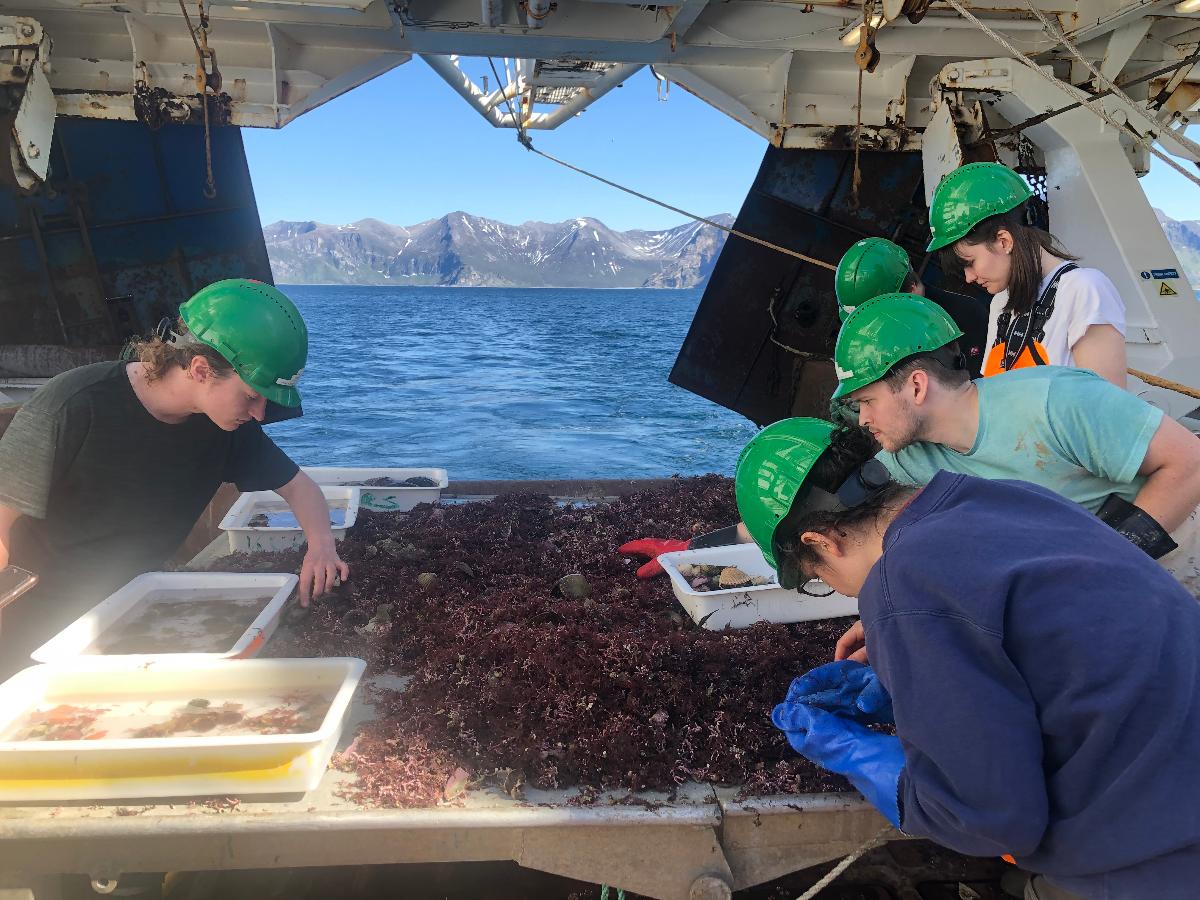
What will you learn?
The specialization Arctic Marine Ecology provides you with advanced knowledge within aspects of Arctic marine system ecology. You will understand how organisms respond to biotic and abiotic factors, the dynamics of primary and secondary production in high-latitude marine ecosystems, the role of trophic interactions in regulating communities and marine food webs, and the functioning of biogeochemical cycles like the carbon cycle in Arctic systems.
You will learn about study designs relevant in marine environments, and critically reflect on the approaches benefits and limitations. You will be able to evaluate diverse information sources and apply your knowledge to societal issues such as marine resource management and pollution control.
Programme description
The ecology of high-latitude coastal and oceanic systems is the focus of this specialization. Polar marine ecosystems, their unique characteristics, and their functioning will be explored. The structure of food webs in various Arctic marine habitats will be examined, along with the requirements for their sustainable use and the influence of the physical environment on species and their ecology. Through a master’s in Arctic Marine Ecology, a wide variety of organisms, ranging from bacteria and plankton to benthos and top predators such as fish and marine mammals, will be introduced. Arctic marine food webs across the entire Arctic can be compared, and the responses of organisms and ecosystems to climate change and environmental variation can be studied.
Students will be an integral part of the Arctic Marine System Ecology (AMSE) Research Group and are expected to participate actively.
For a complete overview of the learning outcomes, please see the programme study plan.
Program Structure
Studyplan(s)
Destinations for studies abroad
Related professions
Do you have any questions?



Følg @uitstudent på Instagram eller TikTok for å få et enda bedre innblikk i hvordan det er å studere på UiT. Her viser studentene fram sin studiehverdag, deler tips og nyttig informasjon, og du kan stille spørsmål om alt du måtte lure på.
Sjekk også @uitnorgesarktiske på Instagram eller TikTok for info om studier, jobbmuligheter og forskning.
