MXD-2 Launch Campaign
MXD2 was launched on 5 July at 8:00 local time (6:00 UT). All science instruments were functional and the recovery was succesful.
The payload was back at the range at approximately 16:30. At the time of the MXD2 flight, the LIDAR measured strong NLC signals around 80 to 82 km and PMSE radar signals were detected between 80 amd 90 km.
First look at the data from the MXD2 in-situ measurements suggest that the ice layer was detected; also neutral air temperature was measured and possibly turbulence.
The two sample collector instruments, MESS and MAGIC, were recovered without damage. They will be opened later under laboratory conditions. The in-situ instruments are being refurbished; the electronics of the instruments will be used for calibration and testing after the flight.
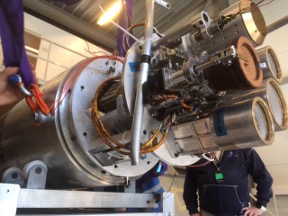
Figure: Science payload after recovery (Photo, I. Mann, UiT).
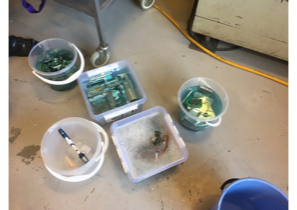
Figure. UiT instrument parts disessambled for rinsing seawater off (Photo, I.Mann, UiT).
Instruments on the ground also monitored the mesosphere before and after the rocket flight. There were clear LIDAR conditions during the night before the launch with a few minutes gap due to clouds around 4.30 UT. About 2 hours after launch the NLC disappeared in the lidar signal for several hours. The MAARSY radar detected PMSE the night before launch and showed moderately strong radar echoes in two distinct layers. EISCAT operation started 5:00 UT and the EISCAT VHF measured PMSE in two distinct layers similar to those observed with MAARSY.
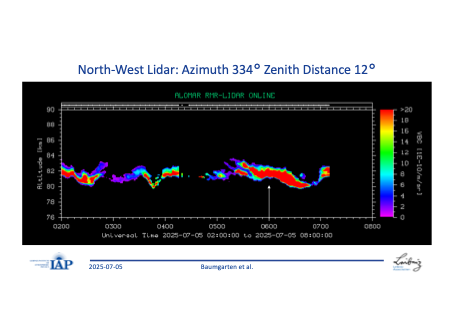
Figure: Observations ALOMAR LIDAR (Courtesy of G. Baumgarten, IAP Kuehlungsborn).
Live stream of MaxiDusty-2 Campaign from @Andøya Space
The launch window is between June 30 th and July 14th, from 7:30 AM to 1:45 PM local time
DAY 6.
Short status report: MXD2 launched at 8:00 local time. All instruments were functional. The recovery was successful and the payload back at the range around 16:30.
DAY 5.
Short status report: We had rainshowers at the range and the lidar was inside the clouds which prevented optical detection of NLC. Both MAARSY and EISCAT radar observed PMSE all day. The PMSE were intially weak and developed in different latyers during the morning. We cancelled the countdown at around 12:30 local time because there was no prospect of conditions improving within the launch window.
DAY 4.
Short status report: We started with better wind condtions than the previous day and they improved further during the morning. The boat was also ready for recovery. PMSE were initially weak and strengthened with time. The lidar, which was operational during part of the launch window, showed only fragments of NLC. With this the science conditions were not met.
DAY 3.
Short status report: The recovery boat returned around to harbour because of poor sea conditions for recovery. Today's countdown has been scrubed after about 20 minutes. EISCAT observations are made as planned. LIDAR will operate as weather conditions permit.
DAY 2.
DAY 1.
Short status report: First day countdown procedure was followed up to – 20 minutes. There were moderate launch conditions in the morning. Radar observations showed PMSE. The lidar could not operate in the morning because of cloud coverage. With this the science conditions were not met.