Outreach
The Earth's Mesosphere
Earth's mesosphere ranges from an altitude of approximately 50 km, culminating in a temperature minimum at altitudes between 80 km and 90 km, known as the mesopause, which marks the boundary between the mesosphere and the thermosphere. The temperature minimum became especially low during the summer in high latitudes, even reaching 100 K due to gravity waves in some rare cases, while the temperature in winter is generally warmer than that in summer, typically above 200 K. The thermal structure of the upper mesosphere is highly complex, with variations in the short time to long-term scales of phenomena. The meridional circulation is believed to be the main reason that summer mesopause is cooler and winter mesopause is warmer.
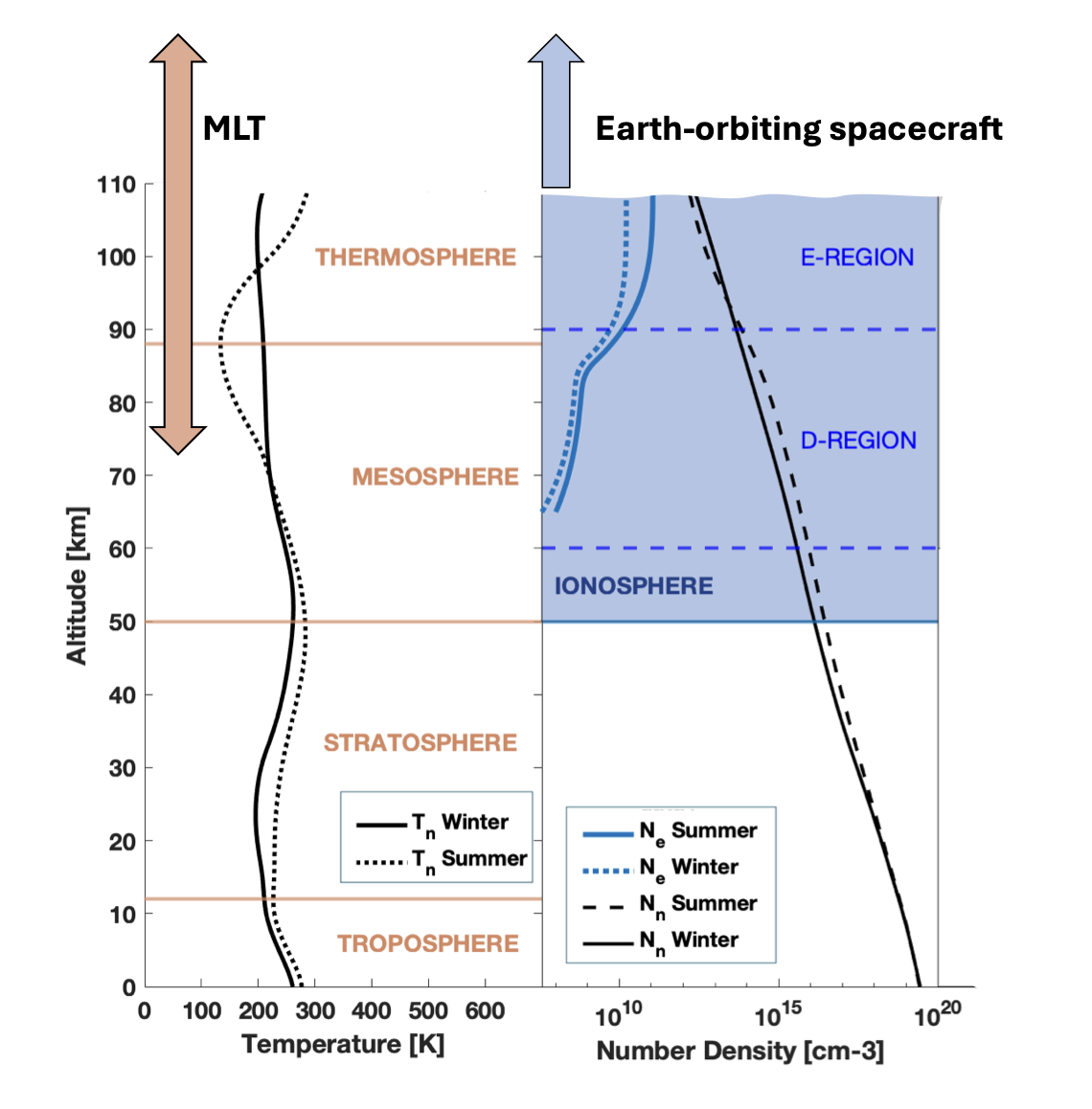
As the cosmic dust particles hit the Earth they are decelerated in the atmosphere which is observed as meteors, and the meteoroid ablates at altitude between 80 and 120 km and the vapors of refractory elements are believed to re-condense into nanometer-sized dust particles, called meteoric smoke particles (MSPs).
During the summer and at mid- and high-latitudes, ice particles can form in the mesosphere due to the exceptionally low temperatures, and the mesospheric dust, consisting of MSP, is believed to contribute to the formation of these icy particles. These ice particles are observed in clouds that we call polar mesospheric clouds or noctilucent clouds, whose appearance has increased over the last 100 years.
The MSP can be electrically charged by electron attachment, radiation-driven detachment, and other ionization mechanisms, and so can ice particles. Because of their charge, the particles influence the electron and ion number density, significantly changing the charge balance and, in turn, affecting the chemical process. The charge also influences the condensation of ice and the growth of MSP.
Stardust in the Arctic — A Micrometeorite Workshop
In CODIA, we study cosmic dust high above the surface of the Earth, around 80 to 100 kilometres up, where particles show up on our radars and are measured by instruments on sounding rockets. The larger ones melt on the way down, and the molten droplet pulls itself into a sphere, so they arrive as tiny magnetic grains. But the story doesn't end there. The dust that doesn't burn up on entry is slowed down and falls silently all around us, including on the roof above your head. In autumn 2026, CODIA hosted a week-long micrometeorite workshop in Tromsø, where students searched for stardust.
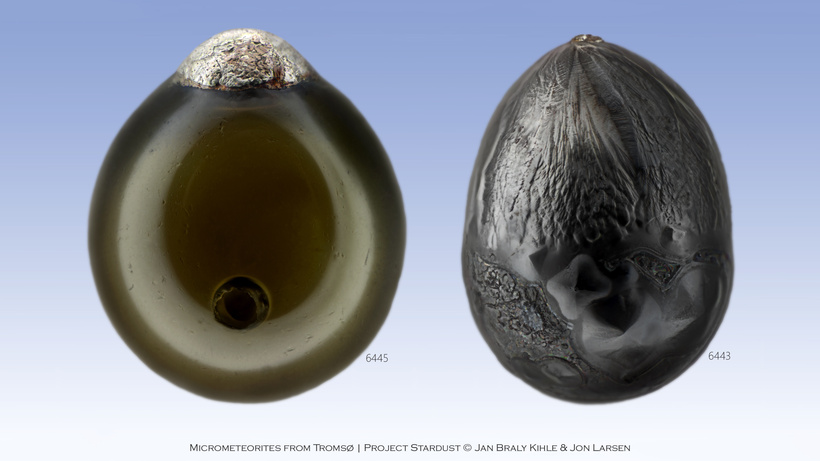
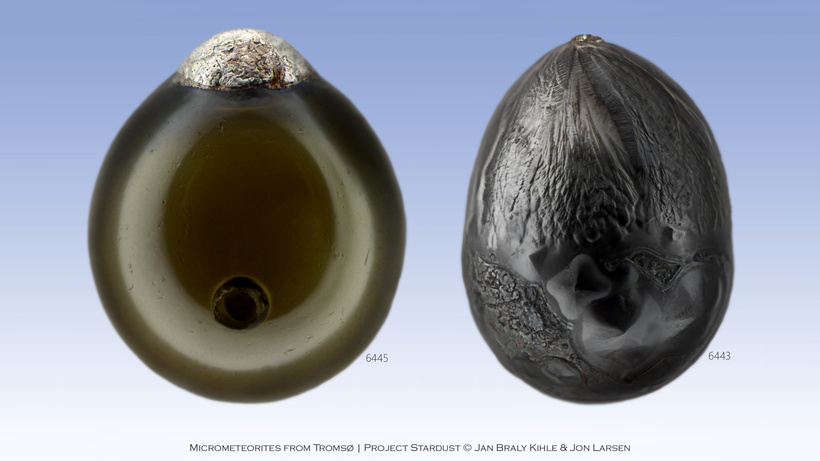
Two of the micrometeorites found during the workshop. Photos: Jan Braly Kihle and Jon Larsen, Project Stardust.
What are micrometeorites?
Tiny stones from comets and asteroids, formed with the Solar System about 4.6 billion years ago. Most are between the width of a human hair and a fine grain of sand.
Why we look
Each grain is a time capsule from the birth of the Solar System. Our instruments pointed at the sky tell us how much dust arrives and how it interacts with the atmosphere, while the grains on the ground tell us what they are made of.
How it's done
- Sweep the dust off a flat rooftop.
- Wash it until the water runs clear.
- Sieve it to separate the 200–400 µm grains.
- Pull out the magnetic particles with a magnet.
- Search under microscopes, and confirm the best candidates with an electron microscope.
Results from the workshop
88 micrometeorites, from clear glass spheres to the striped "barred olivine" grains.
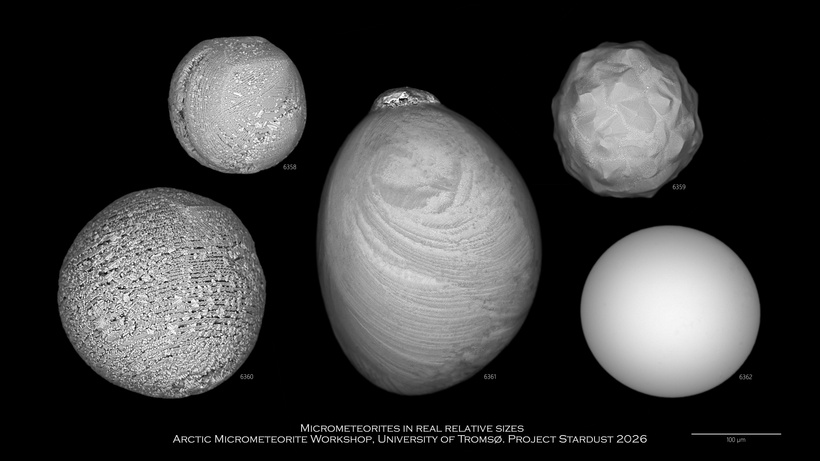
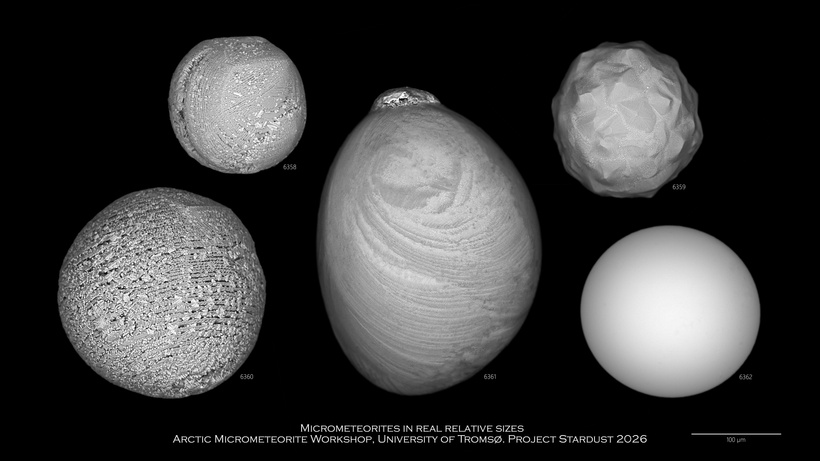
Five of the micrometeorites imaged with an electron microscope. Photos: Carly Faber, UiT, and Jon Larsen, Project Stardust.
For more information on micrometeorites and the workshop, see Project Stardust, run by urban micrometeorite pioneer Jon Larsen:
https://www.patreon.com/ProjectStardust826/posts/arctic-workshop-169319661?utm_medium=clipboard_copy&utm_source=copyLink&utm_campaign=postshare_creator&utm_content=join_link