UA-KLAR Project Kicks Off with Digital Workshop
The UA-KLAR research project was officially launched on 28 April 2026 with a digital kick-off workshop on Zoom. The project aims to strengthen knowledge and competence in Norwegian society regarding Ukraine’s legal framework for economic recovery, EU integration and accountability for war crimes.
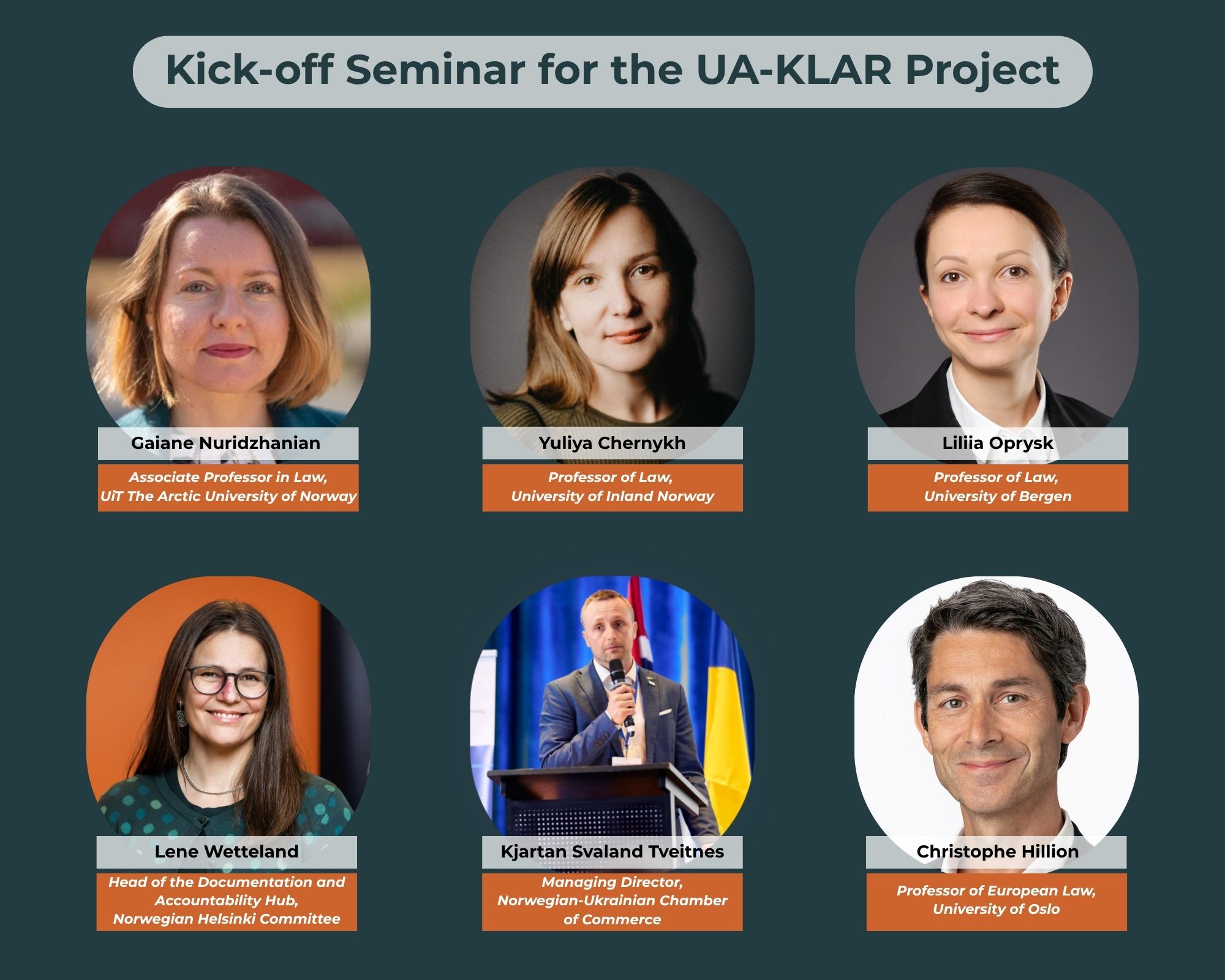
Led by Associate Professor Gaiane Nuridzhanian (UiT The Arctic University of Norway) together with Professor Yuliya Chernykh (University of Inland Norway) and Professor Liliia Oprysk (University of Bergen), UA-KLAR focuses on three interconnected thematic areas: regulation of investments in Ukraine, Ukraine’s relations with the EU and EEA, and justice and accountability for atrocity crimes.
The researchers presented their respective work packages and planned activities, including expert podcasts, public lectures, policy notes and master’s scholarships, while actively seeking input from participants on knowledge needs in Norwegian society.
Advisory Board: Bridging Research and Practice
Members of the project’s advisory board delivered particularly valuable reflections during the workshop.
Kjartan Svaland Tveitnes, Managing Director of the Norwegian-Ukrainian Chamber of Commerce, emphasised the practical importance of the investment track.
- When companies ask whether they can invest, trade or set up operations in Ukraine, the legal framework is one of the first things that determines whether interest becomes a real project.
He described investment decisions as resting on a “triangle of opportunity, risk and predictability” and welcomed the project’s focus on dispute resolution, enforcement of awards and institutions such as the Business Ombudsman. Tveitnes noted strong growth in bilateral trade and Norwegian business interest since 2022.
Professor Christophe Hillion (University of Oslo), an expert in European law, highlighted the significance of Ukraine’s EU accession process for Norway.
- Ukraine will become a large and influential member state in the European Union. Given Norway’s rich relationship with the EU, that influence will spill over into Norwegian life.
He stressed that better-informed Norwegian engagement now will help support Ukraine’s preparation for membership and allow Norway to navigate future developments in areas such as Schengen and other EU-EEA frameworks.
Lene Wetteland, Head of the Documentation and Accountability Hub at the Norwegian Helsinki Committee, addressed the justice and accountability component. Drawing on her organisation’s extensive documentation work in Ukraine since 2014, she discussed challenges in translating documentation into prosecutions and the untapped potential of universal jurisdiction in Norway.
She noted that while Norway has the necessary legislation, practical use has been limited mainly by resources and the need for clear test cases. Wetteland welcomed the project’s ambition to make these complex issues more accessible to the public, thereby strengthening political and societal support for accountability mechanisms, including the Register of Damage and the Special Tribunal for the Crime of Aggression.
Next Steps
UA-KLAR will roll out a series of activities in the coming months. The first events on the topics related to investments in Ukraine will take place already in May and June at INN in Lillehammer. Among the invited speakers are Kjartan Svaland Tveitnes (Norwegian-Ukrainian Chamber of Commerce), Maria Tymofiienko (British Institute of International and Comparative Law), Olena Perepelynska (IMPACTA LAW) and Judge Kostiantyn Pilkov (Supreme Court of Ukraine).
In addition, on 11 June 2026 Dr Dmytro Koval (Co-Director of Truth Hounds NGO and Associate Professor at Kyiv-Mohyla Academy) and Dr Iryna Marchuk (Associate Professor at University of Copenhagen) will visit UiT in Tromsø to discuss challenges in documenting and prosecuting atrocity crimes committed during the war in Ukraine.
For more information about these events, visit the project webpage.