Project Information
MOVA aims to investigate grammatical adaptations and understand multilingual grammatical representation by exploring grammatical changes in the language of Ukrainian refugee children in contact with Polish, Czech, German, and Norwegian.
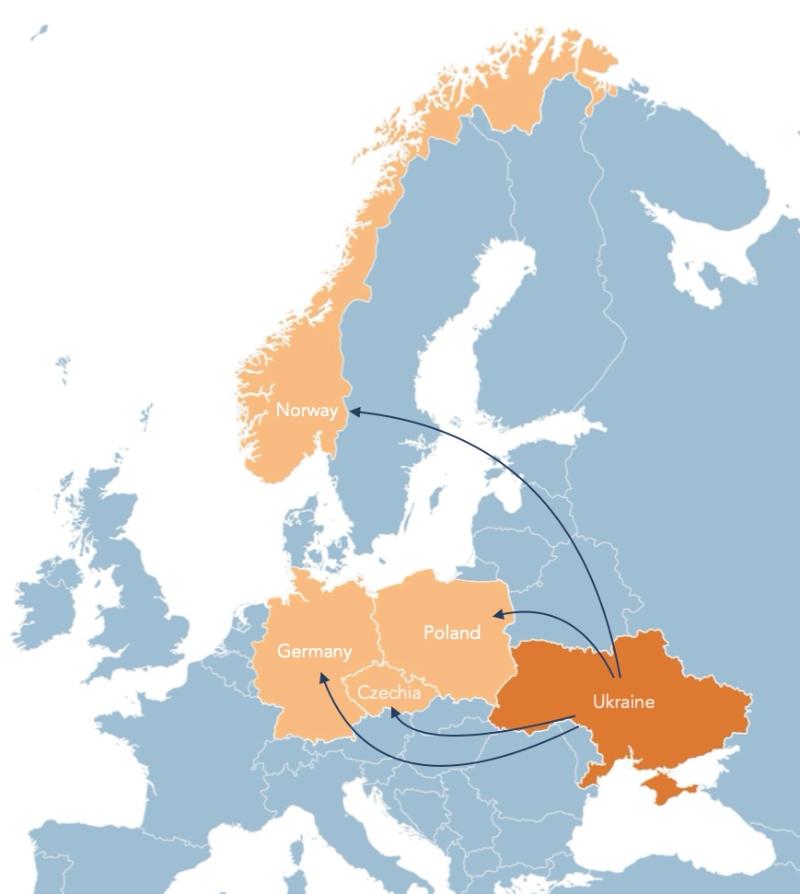 |
| Selected countries in the MOVA project: Germany, Poland, the Czech Republic, Norway. |
After February 2022, over 6 million Ukrainians have fled their home country and are currently residing in Europe, more than 30% of them being children and adolescents. Their multilingual abilities are rapidly changing, with the next couple of years being pivotal in capturing the multilingual dynamics of this population. Simultaneously with the developing competences in the languages of their new host countries, it has become crucial for the multimillion Ukrainian community in Europe to preserve their Ukrainian identity and language in a challenging context when the languages of the new host countries become the dominant languages of communication for the children. Identifying factors that promote additive rather than subtractive multilingualism is therefore of great importance. In this context, the task of understanding the complex dynamics of multilingual language development and maintenance calls for large-scale comparative studies.
MOVA will explore changing language competences in four different linguistic environments – Ukrainian in combination with Polish, Czech, German, and Norwegian – and triangulate cutting-edge theoretical and experimental approaches to multilingual acquisition with advanced statistical modeling techniques. The two Slavic languages, Polish and Czech, are overall more similar to Ukrainian than the two Germanic languages, German and Norwegian. At the same time, certain grammatical properties work differently in the Slavic languages, with Ukrainian sometimes patterning with Polish in contrast to Czech, and sometimes with Czech in contrast to Polish. Similarly, the children’s foreign language, English, which they learn at school, shares some properties with Norwegian, but not German, and in some grammatical respects patterns with Polish/Czech compared to German/Norwegian. We will explore these existing grammatical (dis)similarities between the relevant languages to investigate how grammatical representations come to be linked or shared in a multilingual mind.
The selected countries – Germany, Poland, the Czech Republic, and Norway – are among those with the highest proportions of Ukrainian refugees, facilitating participant recruitment. Recruiting participants from 6 to 16 years of age will enable a detailed investigation how the age at which immersion in a new societal language starts may affect:
- the acquisition of the additional language;
- potential attrition (change) in the first language;
- acquisition of a foreign language in school.
The results of the project will inform a comprehensive model of multilingual grammatical representations and will contribute to developing educational strategies that preserve the children's first languages while enhancing communication skills in the societal languages.
The project will be managed by the Faculty of Humanities, Social Sciences and Education at UiT The Arctic University of Norway and the Center for Language, Brain & Learning (C-LaBL, pronounced ‘syllable’). The full Project Proposal is available online.